

BIO-SECURITY PROTOCOLS
The Science behind cleaning
Author - Matthew Kenneth McDaid
Most service providers treat safety as an afterthought—a checklist completed to satisfy insurance requirements. We treat safety as a forensic discipline: the systematic identification, classification, and neutralization of biological, chemical, and environmental hazards in the built environment. This is not compliance theater. This is ecological risk management applied with the precision of conservation science.
Taxonomic Classification Over Guesswork
Every contaminant is identified by its scientific name—Trentepohlia aurea (red algae), Gloeocapsopsis magma (black crusts), Nostoc commune (slippery biofilms). This is not "dirt." This is biology. And biology requires biological solutions.
Evidence-Based Protocols Over Industry Standards
We do not follow "best practices" inherited from decades of improvisation. We follow evidence-based protocols derived from peer-reviewed ecological research, museum-grade taxonomy (AlgaeBase, Natural History Museum), and substrate-specific chemistry. Our methods are defensible, auditable, and replicable.
Measurable Outcomes Over Verbal Assurances
We do not promise safety. We record it. Every engagement concludes with documented evidence: pH readings (neutral, plus or minus 0.5), contamination checks showing no detectable exposure at the sampled points, photographic records of the exclusion zones, and hazard classifications. This is the Glass Box Standard, where transparency is not a marketing claim but operational infrastructure.
What follows is not a service description. It is the architecture of a discipline.
You will see how hazards are categorised, how protocols are selected, how outcomes are measured, and how the whole system operates as a continuous stewardship cycle rather than a transactional event. This is maintenance as science.
Museum-Grade Taxonomy
Meets Field Operations
Traditional contractors operate on intuition. We operate on classification. Every biological contaminant on your property—from red algae (Trentepohlia aurea) to black roof crusts (Gloeocapsopsis magma)—is identified by its scientific taxonomy and treated using substrate-specific protocols. This is not cleaning. This is forensic ecology: the application of museum-grade biological classification to built environment stewardship. Our protocols are derived from AlgaeBase, the Natural History Museum, and peer-reviewed ecological research—the same standards used by conservation scientists managing heritage sites.
The Bio-Security Protocol Decision Tree
From Chaos to Certainty
Every site assessment begins with hazard classification. The Bio-Security Protocol System identifies ecological risks across three domains — aquatic, mammalian and chemical — and applies evidence-based protocols to reach measurable, documented outcomes. The process is simple to follow: hazard scan, protocol deployment, recorded verification. Every client receives documented, auditable protection for people, pets, property and the surrounding environment.
Transparency as Infrastructure
The Glass Box Standard
We document everything. We hide nothing. Every hazard identified, every protocol deployed, every outcome measured—all recorded, all auditable, all verifiable. Our Bio-Security Protocol System is not proprietary black-box technology; it is open architecture built on scientific transparency. Clients receive full documentation: hazard classifications, protocol specifications, pH measurements, contamination reports, and photographic evidence. This is the Glass Box Standard: where commercial honesty is encoded into the operational system itself. You are not trusting our word. You are verifying our data.

The Encyclopedia of Decay
A living archive of built environment ecology. Every contaminant classified. Every substrate documented. Every protocol tested. This is not a service catalog—this is the foundational knowledge system for forensic asset stewardship in the anthropogenic habitat.

BEEI
Studies how humans interpret contamination and how buildings function as cultural symbols. This discipline examines the psychological, social, and economic dimensions of building maintenance—why certain stains are tolerated while others trigger immediate action, and how perceptions of cleanliness intersect with heritage, status, and identity.

Hazard Pathways

Mammalian Safety

Aquatic Ecology

Chemical Ecology
Systematic classification of biological, chemical, and environmental risks. The diagnostic framework that identifies what threatens your property.
Protocols for keeping pets, livestock and wildlife away from equipment and chemicals. Exclusion zones are agreed, set and checked before work begins.
Barrier and diversion systems that keep run-off out of koi ponds, water features and drainage channels. Checked by pH and TDS reading before and after.
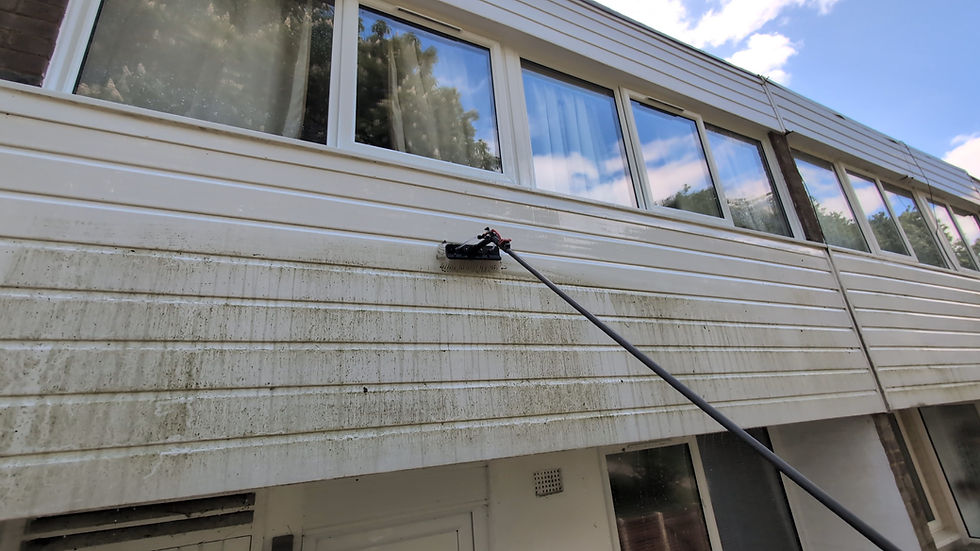
Hydrodynamic protocols using pure water below 1 ppm, meter-verified before each job. No detergents or surfactants are added, so what leaves the building is the water that arrived plus what it lifted — which matters for the substrate and for the water table.

From Discipline to Practice
Understanding the hazard pathways is only the beginning. True stewardship requires a systematic, repeating process—one that deepens with each engagement. The four ecological domains above form the Diagnostic Framework: they tell us what risks exist, where they originate, and how they behave within the built environment.
What follows is the Operational Framework—the 7‑Phase Cycle that converts ecological classification into controlled, measurable, and verifiable safety outcomes.
This is not a one‑time service. This is perpetual architecture.
Each cycle—from Bio‑Hazard Scan through Documentation & Continuous Monitoring—feeds directly into the next, refining the ecological profile of your property with every engagement. Over time, the system shifts from Reactive Maintenance to Predictive Stewardship, creating a living, evolving understanding of your home’s unique environmental signature.
This is what sovereignty looks like in practice: knowledge that compounds, protocols that adapt, and outcomes that can be proven.

Meteorological and geographical datasets, combined with built environment ecology stewardship, through our membership — designed to raise the standard of what this industry records and reports. Where the section above sets out the cycle, membership is how the record of your own property accumulates: every visit adding to a dataset that belongs to the building rather than to us.


Scientific Data in Numbers
350,000,000+ Sequences
Genetic sequence database
GenBank contains DNA sequences for millions of organisms, including the microbes we identify on buildings. When visual identification is ambiguous, genetic barcoding (using sequences from GenBank) provides definitive taxonomic confirmation.
The Three Ecological Domains Explained
The hydrodynamic standard: nothing added to the water
The Challenge: Chemical Run-off
Traditional "soap and squeegee" maintenance creates a toxic run-off event. Detergents and surfactants interact with:
Porous Substrates: Leaching into sandstone and render.
The Biosphere: Altering the soil chemistry of lawns and planted borders.
Drainage Systems: Violating the "Polluter Pays" principle of environmental law.
Our Protocol: pure water below 1 ppm
De-ionisation: source water is filtered to below 1 ppm Total Dissolved Solids, meter-verified before each job.
No additives: no detergents, no surfactants, no harsh alkalis.
Evaporation: the water lifts the dirt and evaporates, leaving no measurable residue on the glass.
Because nothing is added to the water, what runs off is the water that went on plus whatever it lifted off the building.
Input: pure water below 1 ppm, meter-verified.
Output: Safe for limestone, safe for soil, safe for the water table.
Verification: TDS is checked on a calibrated meter before each job and the reading is recorded.


Aquatic Ecology
Water features such as koi ponds, ornamental pools and drainage channels need protecting from run-off and airborne particulates. Aquatic Ecology protocols use engineered barriers and diversion to keep operational water out of the feature rather than relying on dilution.
All water used on site is measured for purity and neutrality before work begins, so that nothing is carried into a sensitive ecosystem that was not already in the mains supply.
How the System Fits Together
The page opens by establishing bio‑security as a scientific discipline, grounding the reader in the idea that every property carries biological, chemical, and environmental risks that must be identified before anything else can happen. The top cards then offer direct pathways into the deeper pages, where each ecological domain is explored in full detail. Immediately after, the coloured blocks provide the on‑page summaries of Hazard Pathways, Mammalian Safety, and Aquatic Ecology, giving visitors a clear, accessible understanding of the system without requiring them to click away.With the domains introduced, the page shifts into the transition section, explaining that these domains form the diagnostic framework — the part of the system that reveals what risks exist and how they behave. This leads naturally into the operational framework: the seven‑phase cycle that turns ecological knowledge into measurable outcomes through scanning, classification, protocol deployment, verification, and continuous monitoring. The cycle shows how each engagement feeds into the next, creating a living ecological profile of the property.After the operational cycle, the scientific data section reinforces the credibility of the system by grounding it in authoritative biological and genetic databases. The page then concludes with the commissioning call‑to‑action, inviting the reader to engage with the system as a structured, evidence‑based discipline rather than a transactional service.