Negentropy: The Physics of Cleaning
Technical / Physics of Hygiene
United Kingdom

Matthew McDaid
03/02/2026
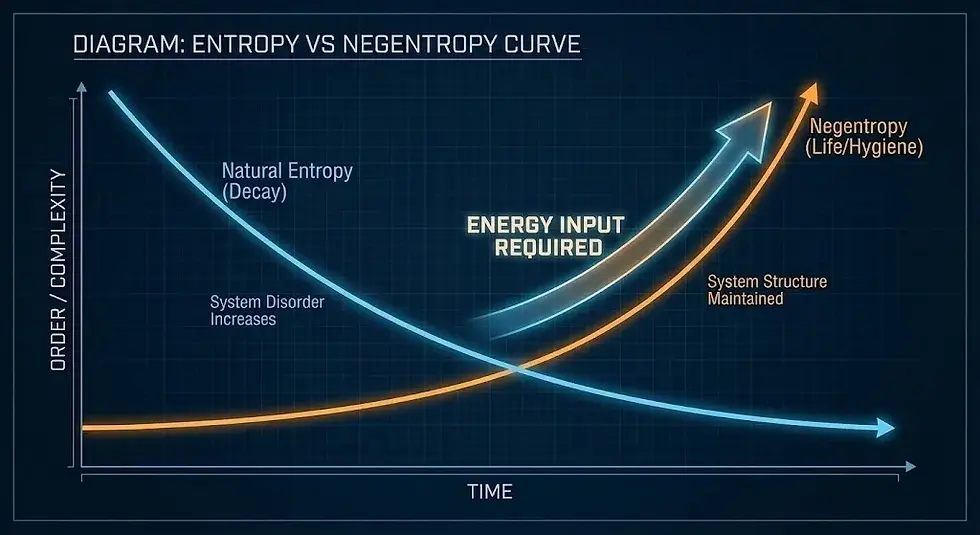
What is Negentropy?
Definition: It is a measure of the order in a system, acting as the opposite of entropy (disorder).
Biological Context: Living organisms are highly negentropic, as they consume energy (food, sunlight) to maintain complex structures and reduce internal disorder.
Information Theory: In statistics, it measures the "distance to normality," representing non-Gaussianity.
Examples: The formation of life, the growth of a child, and the creation of social systems are examples of reversing entropy.
Constraints: While it reduces disorder locally, it requires an, input of energy and cannot occur spontaneously in a closed system.
Origins and Usage
Schrödinger's Concept: Physicist Erwin Schrödinger popularized the term to explain how living systems avoid the inevitable decay predicted by the second law of thermodynamics.
Information Theory: It measures the difference between the entropy of a Gaussian variable and a given distribution.
Applications: It is used in fields such as signal processing, statistics, and organizational manage
The Thermodynamics of Cleaning
In the context of the built environment, dirt, dust, and bacterial growth represent Entropy—the natural tendency of a building to degrade into chaos. A cleaning operative is essentially a "Negentropy Agent." By applying the four factors of the Sinner's Circle (Time, Temperature, Chemical Action, and Mechanical Action), we introduce external energy into the system to reverse this decay and restore the facility to a state of order and hygiene.
"Cleaning is the only industry dedicated entirely to the production of Negentropy. We do not just 'remove dirt'; we actively inject energy to restore order to the built environment."
FM Strategy Lead
The Cleaning Connection
Energy Input vs. Disorder
As noted in the constraints of physics, order cannot happen spontaneously. A room does not clean itself. This explains why "passive cleaning" is a myth. To achieve high levels of hygiene (high negentropy), there must be a significant input of energy. Modern cleaning technology, from autonomous scrubbers to enzymatic cleaners, focuses on maximizing the efficiency of this energy transfer to achieve the highest state of order with the lowest resource cost.
Biological Decay
Without the intervention of cleaning, biological entropy takes over rapidly. Biofilms are essentially organized chaos—bacteria creating their own structures to resist removal. Breaking these down requires specific high-energy interventions (such as steam or aggressive chemistry) to disrupt their stability.
The Role of Automation
Robotics represent a constant, unwavering source of negentropic force. Unlike humans, who fatigue (losing the ability to input energy), robots can apply consistent mechanical action, ensuring that the "reversal of disorder" happens at a constant rate throughout the night.


Environmental Balance
We must also consider the entropy of the wider environment. Using harsh chemicals to clean a floor creates local order but exports disorder (pollution) to the water system. True sustainable cleaning seeks to balance internal order without creating excessive external entropy.
The Human Element
Psychologically, humans crave negentropy. We function better in ordered, clean environments. A "fresh" looking office reduces cognitive load (mental entropy), allowing occupants to focus better. Thus, cleaning provides psychological clarity as well as physical hygiene.
Conclusion
Understanding cleaning through the lens of physics elevates the profession. We are not just wiping surfaces; we are fighting the fundamental laws of the universe to maintain civilization, health, and order.
Similar cleaning news

Thermodynamics in FM
Bacterial Resistance


