The CUBIX Productivity Paradox
Case Study: The CUBIX Productivity Paradox
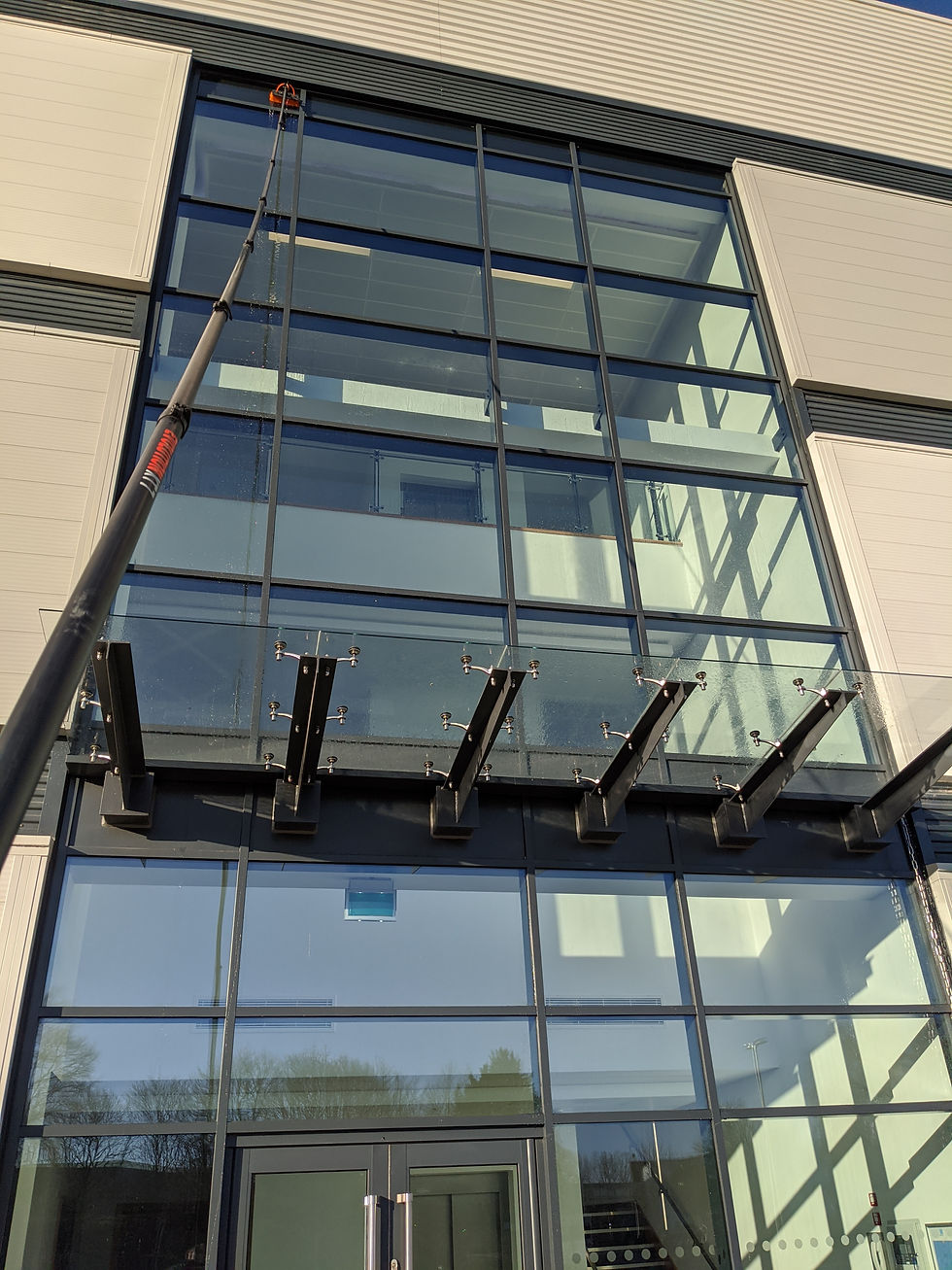
It is a story that we now consider to be a foundational text, a part of our own legal and ethical scripture. It begins, as all good stories do, not with an event, but with a place: Noble House, in Linford Wood, Milton Keynes. A location that is, in itself, a paradox. It is a modern glass-and-steel casement that presents itself as a temple of streamlined, 21st-century commerce.
The irony, we discovered, was almost novelistic. This building houses CUBIX, the proprietor, a "Human-Principled" company whose entire brand is built on removing the "headache" of office life, offering "quality service without expensive gimmicks". And as their tenant, they host Celaton, an "AI-Principled" evangelist for hyper-efficiency, a company that sells the very concept of "streamlining complexities" and "automating repetitive tasks" to global giants like ASOS. A building dedicated, in its very DNA, to eradicating friction. This is the setting. This was the promise.
And then, we were called. Shining Windows. We were commissioned for a complex, full-building clean during a major refurbishment. The exterior glazing was vast, but the real challenge was the high-level internal atrium glass, a space physically impossible to access without specialist equipment. The reception area, with its pristine tiled floors and aesthetic focus, presented an immediate logistical and legal challenge.
The access was, quite literally, "millimetre tight." We had to bring in the smallest-in-industry scissor lift, not through the front doors, but through the double back doors. The floor was a particular point of contention; mats were not permitted. As a sole trader, I, Matthew, had to operate as our own risk assessor. We drafted a disclosure, a legal waiver, stating that we could not be held responsible for any damage to the tiles caused by another company's on-site hire equipment. The client, CUBIX, signed it. This single act of foresight, of legal and systemic prudence, would prove to be critical.
The work itself was a forensic restoration. I completed it alone. The internal glass, coated in fine construction dust, took hours—a slow, methodical dance of piloting the MEWP, ascending, meticulously cleaning the glass and deep ledges by hand, wiping the framework, and descending. The external panels were a testament to years of neglect: baked-on limescale, hard water stains, paint, and burnt-on glues that required heavy-duty TFR and the precise, patient application of an 8-inch Unger blade to restore. The results were transformative. The on-site manager, the human face of the "no-headache" CUBIX, was "over the moon" and promised to be in touch.
Then, the subplot—a fractal of the entire chaotic system—unfolded. I left the scissor lift, as agreed, parked safely opposite the reception desk. The next day, I received a call from the client about cracked tiles. However, the other contractor on site—whose staff were moving the machine "too heavy-handed" and "too quickly"—had already contacted me. Their staff had been honest with their boss, who was honest with me. They had created a "perpetual kind of weight disbursement" by pivoting the 2300kg machine on the delicate floor, and the tiles had cracked. The client called me back, apologetic, confirming we were not associated with the damage and that the other contractor was rectifying their own mistake.
The incident was a perfect microcosm of the entire relationship: chaos, flawed assumptions, and a total lack of internal communication, with Shining Windows—the sole trader—being the only party to have systemically identified the risk, established a legal fact-base, and been vindicated by the truth.
Two years of silence followed that "over the moon" review. Then, the institutional amnesia began. A call would come in. A new manager. A new voice. A polite request for a quote for the exact same complex job. And the same stunning discovery: they had no records. No history. No data. The institutional memory of their own building's maintenance did not exist. For six consecutive years, we became trapped in a "Groundhog Day" loop, a bizarre and harassing "repetitive task" that the AI-tenant in their own building, Celaton, is literally paid to eliminate.
We would, again, have to explain the complexity. We would, again, have to submit the tender. We would, again, detail the logistical necessity of hiring the scissor lift. And the quote would, again, vanish into a bureaucratic void. No acknowledgement. No contract. We were being used as an unpaid data point for their "get 3 quotes" ritual.
Finally, we drew a line. We refuted the flawed system. On the next call, we politely stated that this was the last free quote we would provide, that our administrative time was valuable, and that this cycle was unethical.
The response was not anger, but shame. The manager, "mortally embarrassed," did something no one else had: she investigated. She called back with the truth, the core of the flawed blueprint. "We can't use you," she explained. The reason? "I can't see any headspace for companies that weren't well equipped."
The logic was staggering. They were not looking for a service; they were looking for a company that owned the specific, expensive, indoor-rated scissor lift. They were a multinational-scale business demanding a multinational's asset register, but expecting a sole trader's pricing.
This is where our lived experience became our most powerful data. I transitioned from vendor to consultant. "That," we informed her, "is not how our industry works. You are not looking for a local service. You are looking for a national provider like Mitie, a company with a fleet of thousands." We then provided the data point that shattered their entire procurement model: "A 2019 Skyjack SJ4632, the exact machine for this job, costs £7,500 plus VAT just to buy secondhand. A machine 'designed for rental' is not an asset a sole trader carries for a single site. It is a logistical component to be hired."
We explained that the real cost for the all-inclusive service she was seeking would be £800-£1200, not our hyper-efficient £500-£600 quote. She admitted she was failing to "educate her bosses" on this very fact.
We parted ways with a laugh, wishing her luck. We had "lost" the job. But we had won the entire case study. This experience is the origin story of our new ethos. It is the "Productivity Paradox" in its entirety. A building housing "Human-Principled" simplicity and "AI-Principled" efficiency, completely paralyzed by its own institutional chaos. They were the "cobbler's children," selling streamlined systems to the world while operating on a flawed, repetitive, analogue loop.
This is why we are now architecting our Data-Driven Asset Resilience Reports. Because we learned that high-end clients, drowning in their own noise, don't just need 'a clean.' They need 'logistical certainty' and 'budgetary confidence.' They need what we provided in that final call: a single, predictable, data-driven plan that ends the endless, time-wasting cycle of repetitive quotes. They don't just need a service. They need an architect.