

The Era of Evidence: Why the CMA’s "Green Claims" Crackdown Signals the End of the Vague Narrative.
The "wild west" of sustainability marketing is over. As the Competition and Markets Authority (CMA) launches formal investigations into fashion giants regarding the "Green Claims Code," a new industrial standard is emerging. It is no longer sufficient to claim virtue; one must mathematically prove value.
The era of the "self-verified" marketing claim has officially collapsed. Following a rigorous preliminary review commencing in January 2022, the UK’s Competition and Markets Authority (CMA) has moved from observation to enforcement, launching distinct investigations into ASOS, Boohoo, and George at Asda. The objective is granular and absolute: to determine if the "eco-friendly" and "sustainability" claims made by these entities constitute a misleading of the public consumer.
The CMA’s Green Claims Code now mandates that all environmental assertions must be clear, accurate, and fully substantiated by evidence.
The Silence of the Shams: The Rise of "Greenhushing"
The immediate market reaction to this forensic scrutiny has been a phenomenon termed "Greenhushing". Organizations, paralyzed by the fear of regulatory repercussions and the inability to provide the mathematical proof required by the Green Claims Code, are choosing silence over specification. This retreat reveals a critical weakness in the modern commercial architecture: a reliance on narrative over numbers.
The CMA has explicitly warned that businesses using "vague and broad" statements such as "eco" or "sustainable" without clear descriptors are in violation of consumer protection law. The criteria governing what constitutes a "green" product must be as clear as the criteria governing a "clean" window. It is either verified by the metrics, or it is a fabrication.
This investigation serves as a "shot across the bow" for all industries, not just fashion. The implications extend to the built environment and service sectors. If a business claims to "restore" or "maintain" an asset, they must now be prepared to provide the "full life cycle" evidence of that claim. The marketplace is bifurcating: on one side, those who "hush" because they cannot prove; on the other, those who speak loudly because their data is absolute.

The "wild west" of sustainability marketing is over. As the Competition and Markets Authority (CMA) launches formal investigations into fashion giants regarding the "Green Claims Code," a new industrial standard is emerging. It is no longer sufficient to claim virtue; one must mathematically prove value.
Matthew Kenneth McDaid | The Architect
The CMA’s "Green Claims Code" is not voluntary guidance; it is an interpretation of existing consumer protection law. Non-compliance poses a direct risk of enforcement action and reputational dismantling.
Boxed
Out
The Entrepreneurial
Balancing Act
Verification (n): The process of establishing the truth, accuracy, or validity of a claim through empirical testing and data collection, rather than rhetorical assertion.
The context of this investigation is rooted in a global coordinate sweeping towards transparency. The CMA identified that obscure criteria were being used to define "responsible" product edits, creating a barrier to informed decision-making.
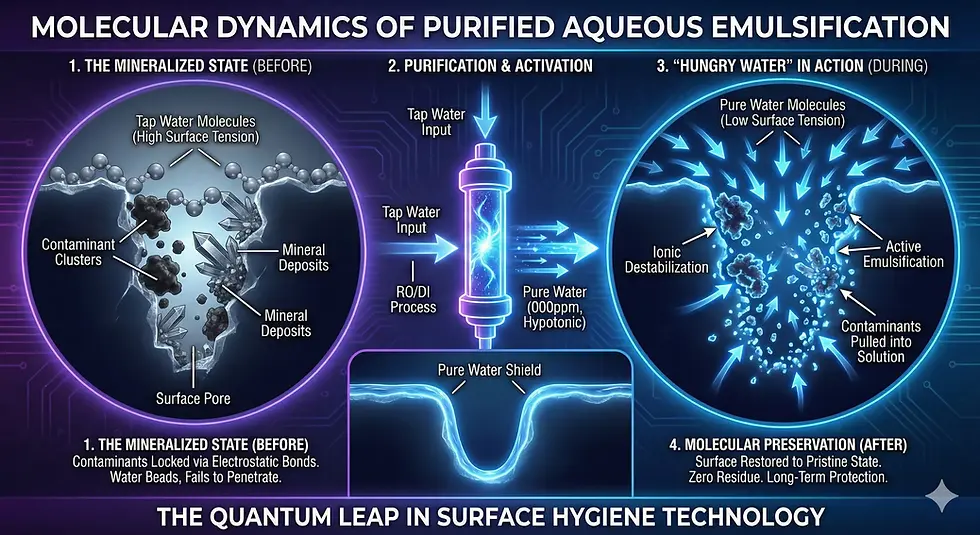
This parallels the challenges in the asset maintenance industry. Just as a "sustainable" shirt requires a supply chain audit, a "clean" building requires a forensic understanding of water purity, hydrophobic interaction, and surface tension. The days of accepting a "visual pass" are ending. The consumer, armed with the skepticism of the CMA, now demands the "criteria for inclusion".
"We won't hesitate to take enforcement action... if we find there is evidence that the green claims made by these companies are misleading shoppers." — Sarah Cardell, Interim Chief Executive of the CMA
TRUST
VERIFIED
From Marketing Fluff to Forensic Facts
THE MYTH: "Sustainability" and "Quality" are subjective terms defined by the brand's marketing department.
THE FACT: Under the CMA Green Claims Code, these terms are objective standards that must be substantiated by clear, accurate, and accessible evidence. Subjectivity is a liability; data is the only asset.
The ultimate victim of "greenwashing" is consumer confidence. When a shopper buys a "sustainable" shirt that is actually environmentally costly, trust is eroded. The same applies to a homeowner who pays for "maintenance" that is merely a surface wipe.
By enforcing these standards, the CMA is essentially demanding a "Million to One" level of attention to detail from the entire British economy. It is a welcome correction. It clears the field of pretenders, leaving only those who have built their business on the solid foundation of provable fact.

Evidence
Northamptonshire / UK Wide
Scope of Investigation: ASOS, Boohoo, and George at Asda under scrutiny for "eco-friendly" claims.
The Violation: Use of vague language and lack of clear criteria for "responsible" collections.
The Consequence: A shift toward "Greenhushing" as businesses fear the inability to substantiate claims.
The Solution: Total transparency and the provision of verifiable data points to the consumer.
Q: Why is the CMA investigating now?
A: A 2021 review found 40% of green claims online were potentially misleading. The CMA is moving from warning to enforcement to protect the integrity of the market.
Q: What is "Greenhushing"?
A: It is the strategic silence of companies who withdraw their sustainability claims because they lack the rigorous evidence required to defend them under the new code.
"In Northamptonshire, the era of the vague promise is over. From the logistics hubs of the M1 corridor to the eco-homes of the Nene Valley, our clients are no longer asking if we are 'Green'; they are asking for the datasheets that prove it."
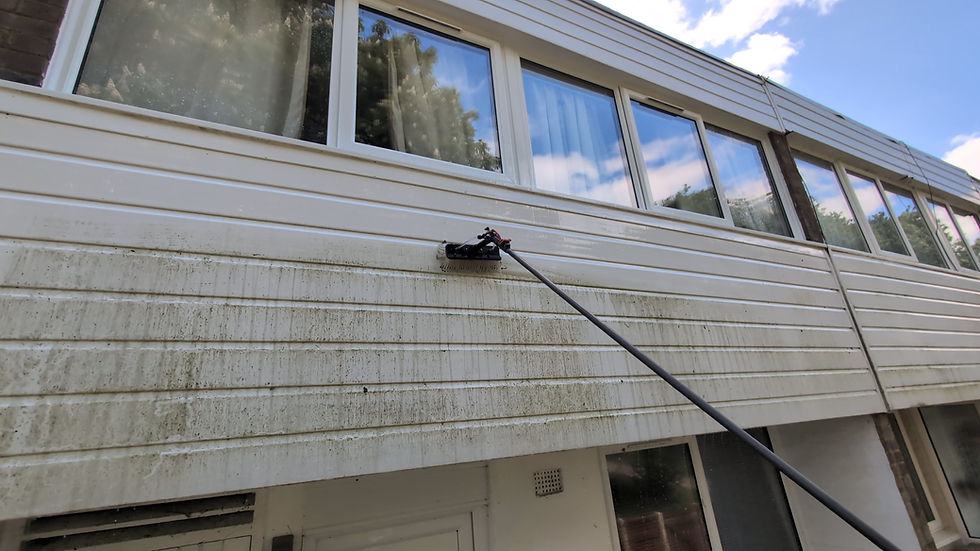
At Shining Windows, we do not suffer from "Greenhushing" because we do not rely on vague adjectives. Our "green" credentials are not claims; they are operational mechanics—pure water, zero chemical residue, and measurable efficiency.
The era of the "self-verified" sustainability claim has collapsed under the weight of its own ambiguity. For decades, the commercial landscape—from fast fashion to property maintenance—has been saturated with the "Marketing Narrative," a rhetorical space where vague adjectives like "eco-friendly," "green," and "sustainable" flourished without empirical definition. This period, characterized by unchecked "Greenwashing," allowed businesses to capitalize on consumer eco-anxiety without altering their underlying physics of operation. However, the intervention of the UK’s Competition and Markets Authority (CMA) via the Green Claims Code, reinforced by the Digital Markets, Competition and Consumers Act (DMCCA) 2024, has introduced a forensic standard that demands the mathematical substantiation of virtue.
The CMA’s investigation into fashion giants ASOS, Boohoo, and George at Asda was the "shot across the bow" for the entire British economy. The regulator’s message was absolute: if you cannot prove it, you cannot say it. This has triggered a phenomenon known as "Greenhushing," where organizations, paralyzed by the fear of fines (up to 10% of global turnover) and reputational dismantling, are scrubbing their websites of all environmental claims. While "Greenhushing" avoids immediate litigation, it represents a failure of industrial courage. It suggests that the business was relying on narrative rather than data. The "Million to One" standard rejects both Greenwashing and Greenhushing in favor of "Forensic Transparency."
Under the new code, a claim must be "clear, accurate, and unambiguous." This requires a shift from qualitative marketing to quantitative evidence. A window cleaning company, for example, can no longer simply claim to be "Planet Friendly." It must specify the mechanism: "We use a Reverse Osmosis Pure Water system that eliminates the need for caustic detergents, reducing chemical runoff by 100% compared to traditional methods." This is not a slogan; it is a falsifiable scientific statement. It transforms the service from a commodity into a verified technical process. The consumer, armed with the skepticism of the CMA, is no longer looking for a "green" badge; they are looking for the "Criteria for Inclusion." They want to see the audit trail of the water, the lifespan of the equipment, and the efficiency of the route planning.
This regulatory environment demands the death of the "Vague Adjective." It elevates the role of Data Sovereignty in marketing. Businesses must now maintain an internal "Evidence Room"—a repository of technical datasheets, supply chain audits, and operational logs that underpin every public statement. The "Green Claims Code" is effectively a truth serum for the market. It clears the field of pretenders who rely on graphic design to convey quality, leaving standing only those operators whose physical reality matches their digital promise. In this new landscape, the only safe marketing strategy is the rigorous presentation of operational fact. Integrity is no longer a moral choice; it is a compliance requirement.
CORE TAKEAWAY: The Green Claims Code demands that claims be "clear and accurate" and "full and substantiating". The era of the vague marketing narrative is dead.
"This investigation is a victory for the forensic mindset. It proves that in the long run, detail, data, and truth are the only sustainable business strategies."

"Thank You for Your Time."
In an era often defined by speed and surface-level narratives, we recognize the value of the reader who seeks depth. Thank you for investing your time in this forensic analysis. We believe that clarity—whether in a pane of glass or a paragraph of text—is the only currency that matters. Your attention to detail mirrors our own, and for that, we offer our sincere gratitude.
If you wish to continue reading, the evidence room remains open.