

Commercial Gutter Clearance — Multi-Let Roofline
Commercial · Gutter Clearance
A multi-let commercial roofline was operating beyond hydraulic capacity, with debris loading threatening water ingress to the building envelope. Cleared under a planned access method, flow restored, and every run photographed before and after.
Closing the Ingress Pathway — Documented Commercial Gutter Clearance, Northamptonshire
A multi-let commercial roofline was operating beyond hydraulic capacity, with debris loading threatening water ingress to the building envelope. Cleared under a planned access method, flow restored, and every run photographed before and after.
Commercial · Gutter Clearance
SW-CASE-GC-COM-001
Thursday, 18 July 2024
Multi-let commercial / industrial unit
Northamptonshire commercial estate · exposed multi-let roofline
Aluminium/steel gutter runs · parapet–wall junction · uPVC downpipes
The Pathology
Inspection identified gutter runs carrying accumulated organic and particulate debris well beyond design hydraulic capacity. Standing water and overflow were tracking to the parapet–wall junction, presenting a measurable water-ingress pathway into the building envelope. Under Applied Exterior Built-Environment Mechanics (AEBEM), this is a root-cause structural risk, not an aesthetic matter: untreated, it escalates toward fabric saturation, accelerated decay, and a probabilistic CAPEX liability the asset record had not captured.
χ Drag Factor
χ — demonstrative: elevated pre-clearance (debris-loaded, retained moisture at parapet junction) → reduced post-clearance
Biomass / Taxon
Mixed organic + particulate debris (leaf litter, moss/algal matter, silt) — composite, not a single taxon
Atmospheric Log
Exposed roofline; wind-loading; seasonal leaf fall; standing-water retention at low-fall sections


The Method
Inspection identified gutter runs carrying accumulated organic and particulate debris well beyond design hydraulic capacity. Standing water and overflow were tracking to the parapet–wall junction, presenting a measurable water-ingress pathway into the building envelope. Under Applied Exterior Built-Environment Mechanics (AEBEM), this is a root-cause structural risk, not an aesthetic matter: untreated, it escalates toward fabric saturation, accelerated decay, and a probabilistic CAPEX liability the asset record had not captured.
For a facilities manager, a blocked gutter is not a cosmetic item; it is an unrecorded liability. Overflow at the parapet drives moisture into the fabric, and the cost surfaces later as reactive repair the maintenance budget never forecast. Scheduled clearance, evidenced and dated, turns an unpredictable risk into a planned line in the budget — and leaves something on file if anybody later asks when the roofline was last cleared.
Worth a word on paperwork, because it is where this trade is thinnest. A useful record is a specific one: each run photographed before and after, the access method written down, the date attached, and a note of what actually came out of the gutter. That is what gets handed over here, and it costs minutes rather than money. Whether any of it ever sits inside a formally certified management system matters far less than whether it exists at all — most gutter work leaves nothing behind but an invoice, and an invoice tells you a payment was made, not that a roofline was cleared.
If you are commissioning this work, the thing worth asking for is not a certificate. It is the detail. Ask how the access will be planned and who is trained to use it. Ask for photographs of every run rather than one representative shot of the tidiest one. Ask whether the outlets were flow-tested or merely looked at. A contractor who can answer those three questions without hesitating is telling you more than any logo on a van.
This case study is a demonstrative model of method, compliance and recording standards. It is not a price schedule; each roofline is assessed and quoted individually following a site-specific risk assessment.
FAQ
How does this satisfy our Work at Height obligations?
Access is planned under the WAHR 2005 hierarchy with a MEWP operated to IPAF standards by an IPAF-trained operator (certification renewal in progress), a documented RAMS and a rescue plan. The method statement and references are recorded against the job, so the access itself is auditable, not assumed.
What evidence do we receive for our compliance records?
Before-and-after imagery for each run, a downpipe flow-test log, RAMS and COSHH references and a dated completion record. It is put together so it drops straight into your own asset records — specific to the job rather than a generic sign-off sheet.
Why schedule clearance rather than wait for a problem?
Because the failure mode is water ingress, and ingress is a capital cost, not a cleaning cost. Scheduled, evidenced clearance is a predictable operational compliance function; reactive response after a breach is an unbudgeted probabilistic liability.
Who carries the risk for work at height on our roofline?
We do, under our own public liability cover and a documented RAMS and rescue plan. Access is planned to the WAHR 2005 hierarchy with an IPAF-trained operator, and the method statement is recorded against the job rather than assumed.
Can clearance run as a scheduled contract rather than a call-out?
Yes, and that is the point of it. A dated, evidenced cycle turns an unpredictable ingress risk into a planned operational cost, and each visit leaves a record in your asset file rather than just an invoice.
The RIsk To Your Asset
The exposure is the building envelope. A run carrying debris beyond its hydraulic capacity overflows at the parapet–wall junction, and that becomes a repeating water path into the fabric rather than a one-off spill. Saturation accelerates decay in whatever it reaches, and the cost arrives later as reactive repair the maintenance budget never forecast. Untracked, it is a liability sitting entirely outside the asset record.
Parapet overflow · envelope ingress
Unrecorded liability · reactive repair cost
Material Substrate
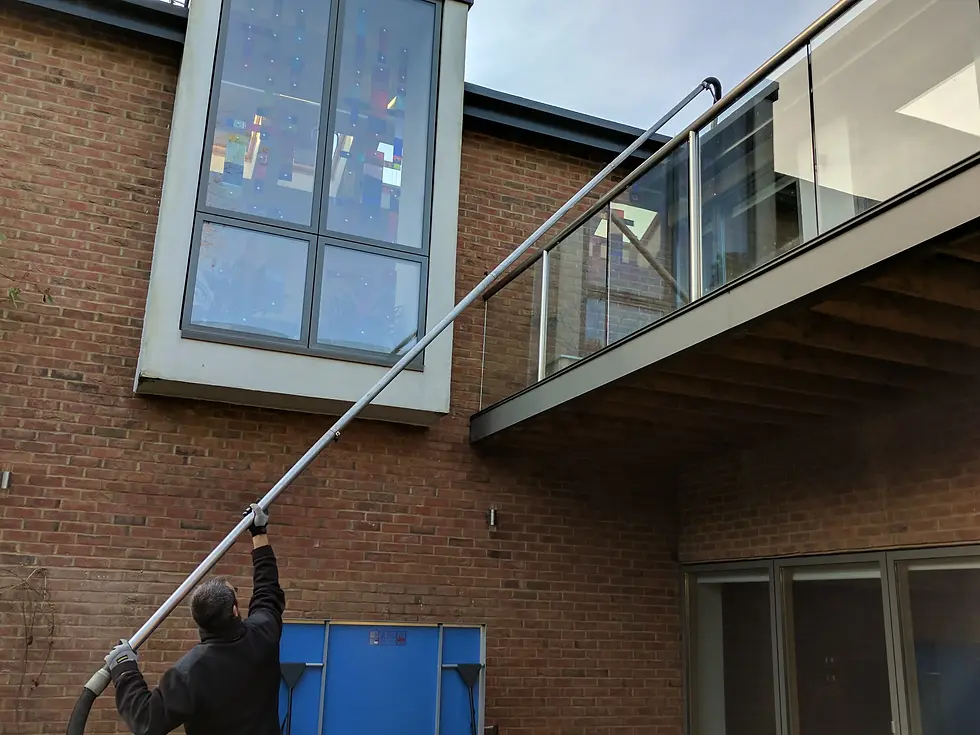
Access was planned under the Work at Height Regulations 2005 hierarchy, using a MEWP operated to IPAF standards (operator IPAF-trained, renewal in progress) with a documented rescue plan. Debris was removed by hand and contained, downpipes flow-tested, and outlets verified clear. Each run was photographed before and after. The output is a dated, photographed record of what was actually done — root-cause mitigation rather than a one-off visit with nothing behind it.
WAHR 2005 · IPAF-operated MEWP
Photographed run by run · evidenced clearance
Specification / Dataset
Substrate: aluminium/steel gutter runs · parapet–wall junction · uPVC downpipes
Loading: mixed organic and particulate debris — leaf litter, moss and algal matter, silt
Gutter runs cleared: 7 runs
Hydraulic capacity: design flow re-established across all runs
Access: MEWP operated to IPAF standards (operator IPAF-trained, renewal in progress) · documented rescue plan
Chronostructural drag χ: elevated → reduced (demonstrative)
Compliance references: Work at Height Regulations 2005 · PUWER 1998 · COSHH
Verification: before/after imagery per run · downpipe flow-test log · dated completion record
Figures: demonstrative — roofline length, debris mass, fall height and RAMS reference to be field-captured
OUR PROTOCOL
Aluminium/steel gutter runs · parapet–wall junction · uPVC downpipes
BIOLOGICAL AGENT
Mixed organic + particulate debris (leaf litter, moss/algal matter, silt) — composite, not a single taxon
SITE / ENVIRONMENT
Northamptonshire commercial estate · exposed multi-let roofline
FORENSIC DETAIL
Inspection identified gutter runs carrying accumulated organic and particulate debris well beyond design hydraulic capacity. Standing water and overflow were tracking to the parapet–wall junction, presenting a measurable water-ingress pathway into the building envelope. Under Applied Exterior Built-Environment Mechanics (AEBEM), this is a root-cause structural risk, not an aesthetic matter: untreated, it escalates toward fabric saturation, accelerated decay, and a probabilistic CAPEX liability the asset record had not captured.
OUTCOME
Hydraulic flow restored across all runs; ingress pathway closed; clearance evidenced by before/after records and a flow-test log. (All figures shown are a Demonstrative Model pending the field-capture job sheet — true debris mass, run lengths, fall heights and flow rates to be entered before publication.)
Your Built Environment
Diverse solutions tailored to your every need

Browse the Shop & Pricing
See every service with clear, upfront pricing — no hidden quotes. Add what you need to your basket and book it in a few clicks, whenever it suits you.

Create & Manage Your Account
Register a free account to manage your services, see past visits and rebook in seconds. Everything about your property's care, in one place.

View the Calendar
See when we're free and choose a date that works for you. Prefer a tailored quote first? Tell us what you need and we'll come straight back.
Book These Services Directly Online






Explore how we restore and protect other residential, commercial, and heritage properties using our evidence-based methods.


