
Lichen Taxonomy
L-Code
Categorization of complex symbiotic crusts, particularly calcicole (lime-loving) species that chemically etch into heritage stone and limestone.
The Ultimate Team-Up
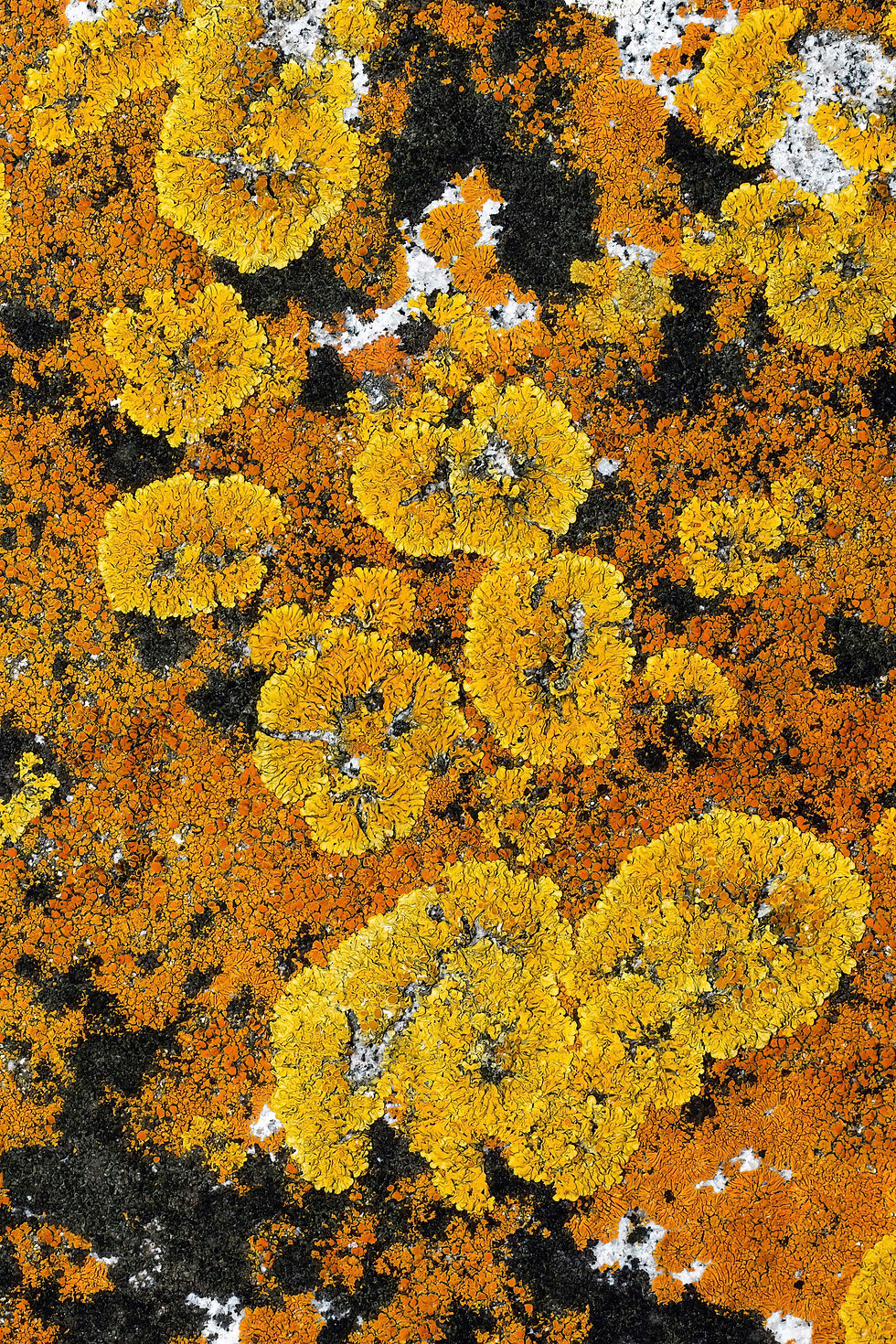
A lichen is not one organism but a partnership. A fungus provides the body, the anchorage and the water-holding structure; inside it lives a population of algae or cyanobacteria that photosynthesise and feed the fungus in return. Neither partner could survive on bare stone alone. Together they are among the most durable living things on the planet, found from Antarctic rock to the ridge tiles of a bungalow in Northampton.
They grow slowly, often less than a millimetre a year, which means the crusty patches on an old wall may be decades old. That slowness is a clue to how firmly they are attached. A lichen has had a very long time to work its way in.
The Black Spot Phenomenon
The small, hard, black spots that appear on Indian sandstone patios and concrete paving, and refuse to come off with anything, are crustose lichens, most often of the Verrucaria group. The bright orange and yellow rosettes on roof tiles and coping stones are Xanthoria, which thrives where birds perch because it feeds on the nitrogen in their droppings. The pale grey and white crusts on limestone are a different community again.
Each tells you something about the stone and the site. But all of them share the same habit: they do not sit on the surface, they grow into it.
Chemical Etching
To anchor itself, the fungal partner secretes organic acids, oxalic acid chief among them. These react with the minerals in stone, mortar and concrete, dissolving calcium carbonate and other cements and leaving behind insoluble oxalate crystals. The fungal threads follow the dissolved channels down into the stone, sometimes several millimetres. The lichen is not glued on. It is rooted in a network of tiny etched tunnels of its own making.
This is why a removed lichen so often leaves a pale ghost of itself behind. The surface under the thallus has been chemically altered and is no longer the same stone as the surface around it.
The High-Pressure Mistake
Because the lichen is bound into the stone, a pressure washer cannot remove one without removing the other. Set high enough to shift a black spot, the jet takes the surface of the stone with it, leaving a pit where the lichen was and a base of fungal threads still in place to regrow from. On sandstone this shows immediately as a rough, sugary patch. On concrete paving it exposes the aggregate. Both surfaces then colonise faster than the original.
Heritage Stone Vulnerability
Lime-loving lichens are drawn to exactly the materials that heritage buildings are made of: limestone, ironstone, and the soft lime mortars between them. On these the etching is real and cumulative, and the temptation to strip a wall clean is strong.
It should be resisted more often than it is. Lichen communities on old stone can be ecologically significant in their own right, some are slow-growing enough to be effectively irreplaceable, and conservation guidance frequently favours leaving them where they are not causing structural harm. On a listed building the decision to remove lichen is a conservation decision, not a cleaning one, and we treat it as such.
Sub-Critical Thermolysis
Where removal is the right call, heat does what pressure cannot. Superheated water delivered at low pressure, well below the point at which it would erode the stone, denatures the proteins holding the lichen together. The thallus loses its grip and can be rinsed away without cutting into the surface beneath it. It is slower than blasting, and it is the only method that leaves the stone as it found it.
On patios and paving where heat is impractical, a biocide with a long dwell time and patient natural weathering achieves the same end over weeks rather than minutes. What we never do is scrape, because a scraped lichen leaves its acid-etched base intact and its fragments scattered.
Symbiotic Architecture
The L-Code investigates one of nature's most resilient colonizers: Lichen. These are not single organisms, but highly complex symbiotic relationships between a fungal host (mycobiont) and an algal or cyanobacterial partner (photobiont), creating a biological entity capable of surviving extreme anthropogenic environments.
Oxalic Acid Secretion
To anchor themselves, lichens do not merely sit on a surface. Species such as the calcicole (lime-loving) varieties actively excrete oxalic acids. These highly corrosive organic acids chemically dissolve the calcium carbonate in heritage limestone, mortar, and concrete, physically etching the organism into the bedrock.
The Risk of Substrate Spalling
Attempting to remove entrenched lichen with kinetic scraping or high-pressure washing is structurally catastrophic. Because the fungal hyphae are chemically fused with the stone, physical removal forcefully tears away the top layer of the masonry, causing immediate and permanent micro-spalling.
Sub-Critical Thermolysis
For high-value or heritage substrates, our protocol dictates Sub-Critical Thermolysis. Utilizing Doff or Therma-Tech systems, we deliver superheated vapor (up to 150 degrees Celsius) at exceptionally low pressure. This thermal shock instantly denatures the proteins within the lichen thallus, allowing safe, effortless removal.
Grade-I & Grade-II Preservation
Listed and heritage buildings need particular care, and cleaning a listed building can require listed building consent from the local authority. Non-abrasive methods protect historic surfaces, and on significant stone the decision to remove lichen at all should be taken with conservation advice.
Conservation Documentation
On heritage work, recording the condition of the stone before and after cleaning, with photographs and notes, gives owners and their advisers a clear account of what was done and why.