

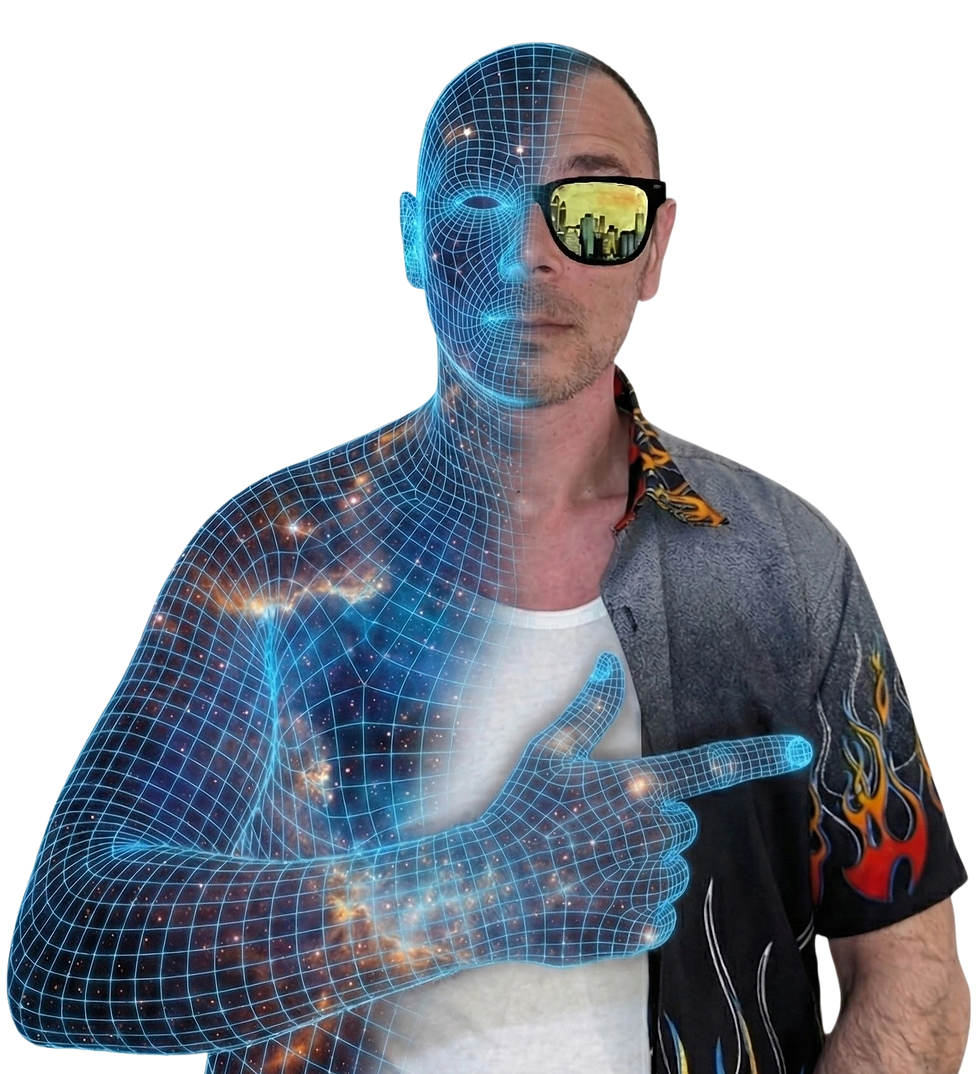
Matthew Kenneth McDaid
BSc (Hons) in progress, The Open University (2026 to 2029/30)
4 October 2026
Matthew Kenneth McDaid is a multi-disciplinary business owner and full-spectrum digital architect who founded Shining Windows in 2001. His expertise rests on a rare combination: strategic business management, scientific search engine optimisation, broadcast-quality media production and more than 25 years of hands-on work on the outside of buildings. He is the author of the Anthrotectonic Hylodynamics framework, the Shining Windows Legal Suite and the industry paper Do With, Not To. He is now studying for a BSc (Honours) in Computing & IT and Psychology with The Open University. Matthew is a disabled business owner. He runs Shining Windows with his partner, Cass.
The people closest to a building know it best, and are asked least. We ask.
Introduction
Matthew Kenneth McDaid is a multi-disciplinary business owner and full-spectrum digital architect with a proven history of founding, scaling and optimising commercial enterprises. His expertise rests on a rare combination: strategic business management, scientific search engine optimisation, broadcast-quality media production and more than 25 years of hands-on work on the outside of buildings.
He has an extensive working understanding of financial oversight, regulatory compliance frameworks (FSA, DPA, HSE) and operational logistics. He uses quantitative and qualitative analysis to drive market penetration, build dominant online visibility and maximise return on investment. He is now adding formal academic study to that practical portfolio through a BSc (Honours) in Computing & IT and Psychology with The Open University. His research interests sit where computing meets human behaviour: human-computer interaction, cognitive ergonomics and the ethics of AI.
Matthew is a disabled business owner. He runs Shining Windows with his partner, Cass.
Why he does it this way
Every building has 2 groups of people around it. One group decides what happens to it: owners, landlords, procurement teams, insurers and regulators. The other group lives with the consequences: tenants, residents, staff, caretakers, and the people who maintain the fabric by hand.
Exterior maintenance workers fit every marker of disengagement that The Open University’s research identifies. They are low-paid and often self-employed, they are excluded from building-science policy, they have no qualification pathway in the care of the building envelope, and they are never asked. Yet a Scholar-Technician on a water-fed pole sees more of a building’s skin in a year than most of the professionals who sign off its condition. They see where moisture lingers, where organic growth returns, where render is failing and where gutters are overwhelmed. That knowledge rarely leaves the van.
There is a reason for that, and Matthew calls it the Regulatory Void. The United Kingdom has a strict framework for building safety, from the Building Safety Act 2022 to the Building Safety Regulator, and a chartered body for almost every profession that touches a building. Yet there are no training programmes, no qualifications, no college courses and no university placements for becoming a Scholar-Ecologist who scientifically maintains the exterior building envelope. Highly qualified graduates in physics, geography, geology and the biological sciences can describe the problem in detail. None of them is trained to stand on the ground and remove the moisture, carbon particulates and mould from a wall without destroying the substrate beneath it. Until that changes, the burden falls on the tenant, the leaseholder and the business that owns the building. Matthew’s response is to build the discipline himself, in public, and to walk the academic path that doesn’t yet exist for his trade.
The Open University’s toolkit Engaging the Disengaged (Smith and Taylor, 2025, PolicyWISE) describes the groups least engaged in public life. They lack power, and they lack proximity to where decisions are made. Disabled people are one of those groups, and so, Matthew argues, is his trade. He belongs to both. The diagnosis applies precisely: the people with the most proximity to the building have the least power over decisions about it.
Matthew’s work is a deliberate attempt to change that, through 3 strands:
The science. He is the author of the Anthrotectonic Hylodynamics framework, which treats the built environment as a living system, and of the Shining Windows building ecology pages.
The records. Every visit ends with a report back. If he has looked, the client will know what he saw.
The legal transparency. He wrote the Shining Windows Legal Suite himself: a full service agreement and its supporting policies, published in plain English with the law behind every term.
His industry discussion paper, Do With, Not To, draws on the toolkit’s principles of transparency, accountability and collaboration and applies them to commercial, heritage and facilities management building care.
We don’t maintain buildings for people. We maintain them with them.
Mapping the environmental substrate
Turning field observation into science means anchoring every record to the landscape it came from. Within the Anthrotectonic Hylodynamics framework, Matthew maps the chemical, geological and atmospheric conditions that drive building decay across the South Midlands, and shapes every protocol around them:
Milton Keynes, Buckingham and Bedford. On the Oxford Clay belt and in the Ouse Valley, the problem is biological colonisation: green algae, black lichen and Gloeocapsa magma. It is treated through soft washing, bio-film abatement and cladding restoration protocols matched to the substrate. Along the grid roads and the M1 corridor, diesel particulates and nitrogen dioxide leave an oily film on glass that tap water cannot shift.
Northampton. Iron-rich soil splash and ferruginous dust from the ironstone geology cause red oxide staining. It is lifted from uPVC, render and masonry with chelating washes that remove the metal ions, rather than with standard detergents.
On glass, everywhere. The standard is optical truth: the accurate transmission of light through a surface free from ionic contamination, hydrophobic film and atmospheric distortion. Pure-water ionic displacement breaks the bond between contaminants and the glass without leaving mineral residue.
Each protocol combines Met Office weather intelligence with British Geological Survey data, and every visit adds to the record. Organising the business around these geo-spatial truths turns field work into an active tracking system for building pathology, and traditional cleaning into forensic asset maintenance.
This is new literature, new terminology and new science. Matthew isn’t borrowing language from adjacent trades. He is authoring it.
How the work connects
Idea on this page | Where it is put into practice | The bridge |
The disengaged trade | The Do With, Not To industry paper | Turning the van into a working field laboratory. |
Data and quantitative analysis | 25 Years of Weather and the Science pages | Scheduling and protocols tied directly to weather records and forecasting. |
Psychology and trust | The Standard of Certainty and the Legal Suite | Replacing the handshake economy with transparent, auditable verification. |
Building ecology | Anthrotectonic Hylodynamics, Building Ecology and the Codex Hub | Treating the building as a living system, recorded visit by visit. |
The Regulatory Void | Your House Your Science | Naming the missing qualification pathway, and building it in public. |
Environmental protection | Bio-Security Protocols and the Glass Box Standard | Recording safety rather than promising it. |
Method and repeatability | The Methodologies Codex | Every service written down as a published, repeatable protocol. |
The Body of Work
Everything on this page rests on a body of published work that Matthew has written and built on the Shining Windows website. Taken together, it is the start of the discipline his trade has never had.
Anthrotectonic Hylodynamics (ATH): the founding doctrine. ATH is the scientific discipline governing how biological, atmospheric, material and ethnographic forces act on the built environment. Matthew founded it as The Architect, working from direct field observation across Northamptonshire, and has developed it across 23 volumes of research and 7 years of biological taxonomy. It reads every surface through 3 axes at once:
Matter: the physics of the substrate.
Life: the biology of the organisms colonising it.
Meaning: how people interpret and respond to what they see.
Its central idea is the Anthrotectonic Rift: the permanent friction between civilisation’s demand that buildings endure and the biosphere’s thermodynamic pull back towards disorder. Its working principle is Operational Determinism. When the biological load, atmospheric forcing, substrate condition and human behaviour around a building are measured, its future condition can be calculated. That makes the built environment a domain that data systems and AI agents can reason about.
Building Ecology: 4 disciplines.
BEMCE (Built Environment Microbial and Chemical Ecology) maps the living interface between biofilms and building materials.
BEEI examines how people interpret contamination, and the effect maintenance has on the surrounding soil and plants.
AEBEM treats the atmosphere as a delivery system for spores and particulates, using Time of Wetness and building aerodynamics.
NEMCE sets the rule that every litre of process water must return to the earth chemically inert.
Together they define the Hylodynamic Gaze: the trained ability of the Scholar-Technician to diagnose invisible vectors of decay before they become visible damage.
The Codex Hub: 17 code families. The Codex Hub is an encyclopedia of built-environment microbiology, organised into code families that run from the A-Code (algae and cyanobacteria) through the F-, L- and MS-Codes (fungi, lichen and moss) to the V-Code (atmospheric vectors) and the Z-Code (geological registry). It identifies organisms by name, including Trentepohlia aurea, Gloeocapsopsis magma, Aureobasidium pullulans and Lecanora muralis, and explains their behaviour, their environmental triggers and the protocols that neutralise them.
The Methodologies Codex: 64 published methodologies. There are 27 commercial, 27 residential, 10 heritage and 1 catalytic. Each sets out its protocol code, access plan, chemistry, pressure limits, statutory anchors and quality checks, from residential window daylight restoration to heritage war memorial bio-security.
Bio-Security Protocols and the Glass Box Standard. Safety is treated as a forensic discipline, not a checklist. Hazards are classified across aquatic, mammalian and chemical domains, and a 7-phase cycle takes each job from bio-hazard scan to recorded verification and continuous monitoring. Pure water below 1 ppm is checked on a calibrated meter before every job, pH is recorded, exclusion zones are photographed, and organisms are identified against AlgaeBase, the Natural History Museum and GenBank. Nothing is hidden: the client verifies the data instead of trusting the word.
25 Years of Weather. A weather history station built from more than 219,000 hourly Met Office observations at the Northampton station from 1999 to 2024. Every service date can be checked against the Work at Height Regulations 2005 thresholds for wind, rain, visibility and ice. Each year from 2001 is written up as its own chapter, with indicators for Bio-Bloom Velocity, Infrastructure Stress, the Stewardship Window and, in the British tradition, a Moan-O-Meter.
The Built Environment. A hub of long-form building science covering Forensic Asset Stewardship, architectural eras and hygrothermal physics, the biology of facades, and the public health cost of poor housing. Three articles stand out: The Wall Is Sweating (retrofit), The Sandstone Is Forgetting (heritage) and The Mould Is a Statutory Object (social housing and Awaab’s Law).
Your House Your Science. An encyclopedia of UK building safety, ecology and residents’ rights. It connects the Building Safety Act 2022, the professional bodies and the path to Net Zero with the biological reality of the buildings people live in.
This is new literature, new terminology and new science, written from the wall upwards.
Proprietor and Chief Digital Strategist, Shining Windows (2001 to present)
Matthew founded Shining Windows in 2001 and built it into a respected, profitable small business, established first in Milton Keynes and then across Northamptonshire, Bedfordshire and Buckinghamshire. Its growth and industry recognition come from operational excellence and a sophisticated, multi-channel digital strategy. As the business’s only principal for most of its life, he has run every division himself: management, marketing, administration, customer service, accounting, and health and safety.
Strategic and financial management
Directs the full profit and loss, cash flow and all financial operations.
Has prepared statutory accounts and handled Corporation Tax compliance, and has a working knowledge of VAT.
Algorithmic and productised operations. Moved the business from the traditional quote-and-handshake model to a transparent, data-driven online system. This brought algorithmic pricing, an online shop with instant prices, live calendar booking, and annual maintenance plans from Bronze to Platinum with loyalty rewards. It is the Standard of Certainty: a “show me” model in place of the industry’s “trust me”.
Implemented a bespoke Customer Relationship Management (CRM) system to manage the client lifecycle from acquisition to retention, increasing lifetime value.
Authored all of the business’s legal and safety documentation: the Service Agreement and Terms of Service, Privacy Policies compliant with the DPA and UK GDPR, and IOSH-standard health and safety risk assessments.
Search and digital visibility
Engineered and executed a data-driven SEO strategy that secured first-page, first-position rankings across a wide range of search terms.
Navigated every major Google algorithm shift, adapting to the content-quality (Panda) and link-profile (Penguin) updates while capitalising on semantic search (Hummingbird) and mobile-first indexing.
Implemented advanced Schema.org structured data (JSON-LD) to secure rich results and lift click-through rates.
Canonical architecture and digital continuity. Built and manages the entire digital footprint himself, with a multi-layered canonical structure that eliminates duplicate content and keeps crawling efficient. It is anchored by the Knowledge Hub, the Built Environment literature, the Codex Hub and the Territories, Pricing and Case Studies hubs, so that dense technical frameworks rank cleanly and build authority without dilution.
Media production
Runs an end-to-end production pipeline for all corporate video, from pre-production storyboarding to post-production.
Directs, films and edits promotional films at up to 8K, using professional codecs (Apple ProRes, Avid DNxHD) and colour grading within the Rec. 709 and Rec. 2020 colour spaces.
Data and building science
Completed a dedicated study of 25 years of local weather records. It now underpins the business’s forecasting, scheduling and building ecology work.
Builds the data systems behind Shining Windows: weather forecasting, databases and AI tooling.
Built the Shining Windows weather history station: more than 219,000 hourly Met Office observations from the Northampton station (1999 to 2024), used to check every service date against the Work at Height Regulations 2005 and published year by year as 25 Years of Weather.
The business is built on reputation. Much of its client base comes from word of mouth, and Shining Windows has received 8 years of industry award certificates, voted among the best in its field, with nominations across multiple years.
Co-Founder and Technical Director, Non-Profit Live Music Collective
Matthew has spent 19 years in live music. For more than 6 of those years he co-founded and ran the complete operational and technical logistics of a recurring non-profit live music event, establishing it as a key fixture of the regional arts scene.
Technical production and engineering
Designed and executed the complete technical rider for every event, managing signal flow across multi-channel audio set-ups.
Worked as lead front-of-house (FOH) engineer on digital mixing consoles (Behringer X32, Yamaha TF series), deploying dynamic (Shure SM57 and SM58) and condenser microphones to suit each source.
Programmed and operated synchronised lighting shows using DMX512 controllers, PAR cans and moving heads.
Operational management
Oversaw Health and Safety Executive (HSE) compliance for venues, including electrical safety (PAT), public liability and crowd management risk assessments.
Showed real leadership and operational resilience when the management team reduced from 7 to 2 principals, keeping event quality and frequency unchanged.
Client Adherence and Financial Services Officer, TSYS Managed Services and Merchants
Matthew worked within the highly regulated UK financial and customer service sectors, ensuring strict adherence to legal and corporate standards while resolving complex client issues.
At Merchants, a Dimension Data Group company providing customer contact solutions to blue-chip organisations worldwide, he provided solutions tailored to each customer’s operation. The aim was to balance performance, risk and cost so that the contact centre became a customer relationship building tool. He completed 6 weeks of intensive training across every part of the role, covering:
sales approach techniques and performance management
basic accounting principles, database knowledge and financial transactions
reflective customer handling
He kept a personal record of every case and reported daily and weekly to team leaders for management reporting.
At TSYS Managed Services he completed compliance examinations on Financial Services Authority regulations.
Regulatory compliance and risk management
Worked in strict accordance with FSA regulations, including Treating Customers Fairly (TCF) principles and anti-money laundering (AML) checks.
Kept all data handling and transactions compliant with the Data Protection Act 1998 and the Payment Card Industry Data Security Standard (PCI DSS).
Customer and systems interface
Used proprietary CRM and financial transaction platforms to manage customer accounts, investigate transactional anomalies and process sensitive data.
Acted as a primary point of resolution, de-escalating complex situations and providing solutions within regulatory and business constraints.
Earlier roles included temporary agency contracts. At Candu Entertainment (Shout), he ran early-morning car park operations, petty cash and daily accounts.
How he leads
Leadership. Set the standard you want the trade to reach, then publish it: methods, terms and the science behind them.
Integrity. Every price itemised, every visit recorded, every promise written down and open to challenge.
Seeing what is actually happening. Be on the wall, in the gutter and on the roofline. Record what you see, report it back, and turn it into evidence.
The pattern of dirt on a facade is a map of how air and water move across it. Clean upper corners and grime lower down show where wind-driven rain falls. A dark stripe below a sill with no drip groove shows where run-off keeps the wall wet, and a sheltered corner under the eaves shows where spores settle and stay. Reading that pattern lets Matthew advise owners on the cause, not just the symptom.
Clean the whole wall, but read it first.
Trust isn’t asked for. It’s recorded, reported and earned on every visit.
Guiding philosophy
As an intellectual practitioner, Matthew is driven by a deep curiosity about how technology, sociology and human psychology interact. He sees them not as separate fields but as interconnected systems that together describe the reality we work in. That view drives a continuous pursuit of knowledge, expressed equally through technical work and creative work.
His core method is first principles thinking. Rather than relying on analogy or received wisdom, he breaks every challenge down to its most fundamental truths, whether it is a business obstacle, a technical problem or a creative block. Taking a problem apart this way removes flawed assumptions, and it is the foundation for solutions that are innovative and robust.
He works through a balance of quantitative analysis and qualitative intuition. He is committed to data-driven decisions, because evidence and rigour are how you navigate uncertainty and manage risk. He also knows that data alone is not enough. His analytical side is balanced by a creative intuition developed over years as an accredited musician (Grade 6 drums, Grade 5 guitar), songwriter and audio producer. For him, music is part of the professional toolkit. The structure, harmony and dynamics of composition inform how he designs systems, and the improvisation of live performance gives him the agility to respond to the unexpected in any project.
He is an optimist, convinced that any challenge, whatever its scale, can be overcome through focused diligence and a well-structured strategy. That belief rests on honesty and integrity. His ultimate motivation, the “why” behind every project, is to build a lasting legacy of purpose, innovation and integrity, and it is reinforced every day by his most important role: proud father to his 2 daughters and dedicated partner, Cass, as he calls it “we’re cleverly disguised as responsible adults” #parenting
Beyond work
Philosophy and sociology are lifelong interests, studied and lived day to day. Matthew learns by talking to people in different environments, and communication is something he puts himself into all the time. He draws, designs and builds websites, and has built and managed the Shining Windows website himself from its first version. He loves the outdoors, being with nature, and time with his dog.
People who work with him describe someone honest, polite and personable, who speaks his mind with good humour and courage: direct, reliable, confident and, above all, approachable.
An ongoing journey
Through all of these roles and all of this learning, one thing has become clear to Matthew: the journey has no final destination. Each skill learned, project completed and challenge overcome is a step on a longer path of discovery, not an endpoint. He approaches it with intellectual humility, because the more he learns, the more of the unknown he can see.
His commitment is not to a rigid career plan but to continuous growth. He treats every misstep as a data point and stays open to other people’s perspectives. He accepts the world in all its complexity and imperfection, and lives with intention and awareness, day by day.
Stop. Look. Listen. Then clean.
Qualifications, training and expertise
Matthew’s qualifications combine formal study, professional training, industry recognition and more than 25 years of continuous practice.
Formal qualifications
NVQ Level 1 and Level 2 in Information Technology, Milton Keynes College, 2004 to 2005. Foundational training in computer hardware, operating systems and network principles.
Contemporary Music Performance, from recognised UK examination boards: Grade 6 with Distinction (Drums) and Grade 5 with Distinction (Guitar).
Professional development and certifications
Digital marketing: Google Analytics IQ (GAIQ); Google Ads professional certification.
Business and safety: IOSH Managing Safely; Health and Safety (HSE) Working at Height; Introduction to UK Business Law and Contract Management.
Financial services: PCI DSS Awareness Training; FSA Regulatory Frameworks Training, with compliance examinations completed at TSYS Managed Services.
Customer contact: 6 weeks of intensive in-house training at Merchants (Dimension Data Group), covering sales, account handling, problem resolution and reporting.
Registration
Registered waste carrier (lower tier), Environment Agency, registration CBDL622625.
Industry recognition
8 years of industry award certificates, voted among the best in the field.
Nominated for industry awards across multiple years.
Areas of strategic expertise
Area | Expertise |
Corporate strategy and financial oversight | Profit and loss management, business process re-engineering, capital and operating expenditure planning, market penetration analysis, competitive intelligence, risk and compliance governance (HSE, IOSH principles), statutory and management accounting. |
Scientific SEO and digital architecture | Algorithmic analysis and adaptation (core updates, E-E-A-T signals), technical SEO (crawling, indexing, canonicalisation, hreflang), semantic schema markup (JSON-LD), off-page authority development, quantitative analytics and API integration (GA4, GSC). |
Media production and creative direction | High-bitrate video workflow management (8K RAW, ProRes 422 and 4444), colour science and grading (Rec. 2020 and Rec. 709, ACES), advanced non-linear editing, audio post-production (dialogue, Foley, score), brand semiotics. |
Technical event and operations management | Large-scale event logistics and critical path analysis, technical rider design and execution (audio, visual, lighting), live sound reinforcement (gain staging, FOH and monitor mixing), DMX512 lighting programming. |
Building envelope care and building ecology | Residential, commercial, facilities management and heritage exterior care. Risk assessments and method statements. Weather-led scheduling. Author of the Anthrotectonic Hylodynamics framework. |
Forensic ecology and bio-security | Taxonomic identification of biological colonisers, hazard classification across aquatic, mammalian and chemical domains, TDS and pH verification, run-off management and the Glass Box Standard of recorded outcomes. |
Technical and systems expertise
Operating systems and scripting. Microsoft Windows 11 Pro and Server: deployment, administration and security hardening, with configuration through Group Policy Objects and the Registry Editor, automation in PowerShell and Batch, NTFS permissions and BitLocker encryption. Full operational proficiency in macOS for creative production, and working knowledge of Linux (Ubuntu) for server management and Bash.
Networking and security. Practical understanding of the TCP/IP suite across OSI layers 2, 3 and 4, covering:
configuration of DNS, DHCP and LAN, WAN and WLAN topologies
deployment of routers, managed switches (including VLANs) and wireless access points
stateful firewalls, NAT, port forwarding and wireless security (WPA3, 802.1X and RADIUS principles)
diagnostics with ping, traceroute, nslookup and Wireshark
Web technologies and content management. HTML5 semantic structure, CSS3 (Flexbox and Grid), and vanilla JavaScript for DOM manipulation and interactivity. WordPress theme architecture including parent and child themes, custom post types and plugins. WooCommerce and Shopify (including Liquid templating principles), payment gateway integration and inventory management. Wix CMS collections and dynamic pages. Server administration through cPanel and Plesk, FTP and SFTP, and DNS records (A, CNAME, MX, TXT).
Data systems and AI. Weather forecasting models, databases (Supabase) and AI tooling, including Model Context Protocol (MCP) integrations, built around the Shining Windows weather records and site data.
Digital marketing and analytics. Google Marketing Platform (GA4, GSC, GTM), including GA4 event-based modelling and monitoring of Core Web Vitals. SEMrush for competitor intelligence and Ahrefs for backlink analysis. Site auditing with Screaming Frog and Sitebulb to resolve crawl errors, redirect chains and canonicalisation issues. On-page optimisation through TF-IDF analysis and internal linking. Google Ads campaign structure, keyword bidding and Quality Score.
Video and post-production. Adobe Premiere Pro (multi-cam editing, proxy workflows for 8K and 4K RAW). DaVinci Resolve node-based grading in an ACES colour-managed pipeline. Adobe After Effects (compositing, 3D camera tracking, rotoscoping, keying, motion graphics) and Adobe Audition. Professional codecs (Apple ProRes 4444 XQ, Avid DNxHD and DNxHR) and HDR delivery.
Audio engineering and music production. Logic Pro X, Pro Tools and Ableton Live for MIDI sequencing, multi-track recording and mixing, including sidechain and parallel processing. Mastering to LUFS loudness standards. Stereo microphone techniques (X/Y, Mid/Side) and polar patterns. Signal flow from preamps and interfaces (Focusrite, UAD) to output. Music theory, composition, arrangement, and notation in Sibelius and Finale.
Business operations and project management. Advanced Excel (VBA macros, Pivot Tables), data visualisation principles (Power BI, Tableau), Agile and Kanban methods, CRM principles (Salesforce, HubSpot), Sage and QuickBooks, and Microsoft 365.
Experience as evidence
Area | What it rests on |
Exterior building care | Self-employed since 2001 across residential, commercial, facilities management and heritage work, in Milton Keynes and Northamptonshire. |
Health and safety | A risk assessment and method statement before every commercial contract. HSE venue compliance for live events. IOSH and Working at Height training. |
Business and finance | Sole management: profit and loss, cash flow, statutory accounts, Corporation Tax, Self Assessment and CRM. |
Legal frameworks | Author of the Shining Windows Legal Suite: the Service Agreement and its supporting policies. |
Building science | Author of the Anthrotectonic Hylodynamics framework and the Do With, Not To discussion paper. A dedicated study of 25 years of weather records. |
Digital architecture | Websites, SEO and structured data. Data systems, forecasting and AI tooling today. |
Media and live production | 8K film production and colour grading. 19 years in live music, more than 6 of them as co-founder and technical director. |
Regulated services | Customer contact and financial services under FSA rules, TCF, AML, DPA 1998 and PCI DSS. |
Methodology authorship | 64 published methodologies across commercial, residential, heritage and catalytic work, each with its own protocol, access plan and statutory anchors. |
Taxonomy and classification | The Codex Hub: 17 code families of built-environment microbiology, materials, atmosphere and geology. |
Environmental protection | Bio-Security Protocols: meter-verified pure water, recorded pH, exclusion zones and run-off barriers for ponds, soil and drainage. |
Building safety and regulation | Your House Your Science: the Building Safety Act 2022, residents’ rights, the professional bodies and the Regulatory Void. |
BSc (Honours) Computing & IT and Psychology (Q67)
The Open University · Part-time · Started 3 October 2026 · Expected completion 2029/30
Starting this degree changes the shape of Matthew’s plan, not the goal. Computing & IT with Psychology isn’t a detour. It gives him the 2 skills his environmental work will need most:
Data systems. The computing half supports his weather forecasting, database and AI work, built around 25 years of weather records and site observations. He will steer his modules and final project towards building data: sensors, databases, AI and forecasting.
Human behaviour. The psychology half covers why customers and clients trust, delay or disengage. These are the themes at the centre of the Open University toolkit and his own Do With, Not To paper.
Environmental science becomes his second qualification, starting in 2030.
Where the degree meets the published work
Computing and the data engine. The 219,000 hourly weather observations, the String Diagnostics (S-Code) predictive algorithms for a building’s rate of decay, and the MCP data engine are all computing problems. The degree gives them formal grounding in databases, algorithms and AI.
Psychology and the Meaning axis. BEEI and the Meaning axis of ATH study how people interpret contamination: why one stain is tolerated and another triggers action, and how cleanliness connects to status, heritage and identity. Psychology gives that work the research methods to test it.
Both together and the Glass Box Standard. Recording outcomes so that clients can verify them is a question of data design and of human trust at the same time.
Alongside the degree
Continuing to author the Anthrotectonic Hylodynamics framework, and preparing papers for peer review.
Short courses, certificates and participation programmes that support the business and the science.
The goal stays fixed. The route is planned one stage at a time.
The path
Phase | Years (part-time) | What | How it serves the business and the science |
1. Current degree | 2026 to 2029/30 | BSc (Hons) Computing & IT and Psychology (Q67) | Modules and a final project pointed at building data: sensors, databases, AI and forecasting from 25 years of weather records. Psychology covers why clients trust, delay or disengage: homeostasis. |
2. Environmental foundations | 2030 to 2032 | Master of Environmental Science (M05), Stage 1, including U116 Environment: journeys through a changing world | The natural and social science base, with the Certificate of Higher Education as a built-in exit award. |
3. Core science | 2032 to 2034 | S226 Environmental science · S286 Biodiversity · T213 Energy and sustainability | Soil, water and atmosphere processes; algae and fungi, the organisms on the walls he treats; net zero and solar. Exit award: Diploma of Higher Education. |
4. Specialist and research | 2034 to 2036 | S397 Terrestrial ecosystems · S350 Evaluating contemporary science · SDT306 Environment: responding to change | Ecosystem monitoring and professional reports, testing research claims, and a local investigation: a Northamptonshire building study. Exit award: BSc. |
5. Masters year | 2036 to 2038/39 | M05 final stage | Remote sensing and climate modelling, combined with the computing degree: building science, data and people, all at Masters level. |
6. Doctorate | After the Masters | PhD, part-time | One original research project bringing all 3 fields together. |
The end point of the integrated route, around 2038/39, is a BSc in Computing & IT and Psychology plus a Master of Environmental Science. That combination is rare in building maintenance and directly supports building ecology.
How each stage feeds the framework
Stage | Module or award | What it strengthens in the published work |
1 | Q67 Computing & IT and Psychology | The weather station, the String Diagnostics (S-Code), the data engine, and the Meaning axis and BEEI. |
2 | U116 Environment: journeys through a changing world | The wider context of Your House Your Science and the path to Net Zero. |
3 | S226 Environmental science | AEBEM, the Atmospheric Triggers (AT-Code), the Atmospheric Vectors (V-Code) and the Geological Registry (Z-Code). |
3 | S286 Biodiversity | The Algal, Fungal, Lichen and Moss codes (A, F, L and MS), and the organisms on the walls he treats. |
3 | T213 Energy and sustainability | Solar panel performance, Quantum Diagnostics (Q-Code) and whole-life carbon. |
4 | S397 Terrestrial ecosystems | NEMCE and BEEI: soil microbiomes, run-off and the closed loop. |
4 | S350 Evaluating contemporary science | The Glass Box Standard and the evidence behind every published claim. |
4 | SDT306 Environment: responding to change | The local Northamptonshire building study and the Geological Registry. |
5 | M05 final stage | Remote sensing and climate modelling for the weather station and predictive stewardship. |
6 | PhD | BEMCE and the time-to-failure models at doctoral level. |
Running alongside the studies
Milestone | Target | What it brings together |
The data engine | 2026 to 2027 | Model Context Protocol (MCP) infrastructure joined to the Shining Windows environmental data, so that Met Office weather intelligence and local site records feed predictive building care schedules. |
A decision point in 2029
Once Q67 is complete, Matthew will hold an honours degree, which opens a second route: a postgraduate environmental MSc. It takes 2 to 3 years instead of 8 and would finish around 2032/33, leaving 6 extra years to apply it. The trade-off is less depth in the underlying ecology and fieldwork, which is the part building ecology relies on most.
So the M05 route builds the deepest science, and the postgraduate route reaches a Masters 6 years sooner. The decision will be made in 2029.
The doctorate
Matthew will need only one doctorate, not one per field. A PhD isn’t more modules. It’s 1 original, supervised research project, ending in a thesis (usually 80,000 to 100,000 words) and an oral examination, the viva. His 3 fields come together in a single interdisciplinary question, for example:
Moisture, microbial colonisation and the maintenance of building envelopes: a data-driven ecological model and its adoption by building owners.
Environmental science covers the biology and moisture, computing covers the data and modelling, and psychology covers how people engage with maintenance decisions.
What matters most is the research question, not more qualifications. The Masters provides the research training. After that, success depends on a well-defined question, the right supervisor and good data. His 25 years of weather records and site observations are a real head start.
Where it leads
Route | Study | Expected finish | Title |
Integrated Masters to 2039, then PhD | PhD part-time, 6 to 8 years | About 2045 to 2047 | Dr Matthew Kenneth McDaid BSc (Hons) MEnv PhD |
Postgraduate MSc (about 2030 to 2033), then PhD | PhD part-time, about 6 years | About 2039 | Dr Matthew Kenneth McDaid BSc (Hons) MSc PhD |
PhD by published work | Peer-reviewed research plus a commentary of about 10,000 to 20,000 words | 1 to 2 years, once the papers are published | The same title |
The faster route reaches a doctorate in roughly the same timeframe in which the integrated route reaches the Masters. The published-work route opens if 2 or 3 Anthrotectonic Hylodynamics papers pass peer review during the degrees. The source material already exists: the 23 volumes of ATH research, the Codex Hub, the Building Ecology disciplines and 25 years of weather data.
Future study considerations
These courses remain on Matthew’s longer list. Each would add something specific to the business, the science or the ecology.
Course | Code | What it would add |
Renewable energy | T313 | Solar thermal, solar PV and wind in depth, for the energy side of building care. |
Diploma of Higher Education in Design and Innovation | W73 | Design thinking for turning Shining Windows systems into products and services. |
BA/BSc (Hons) Design and Innovation | Q61 | The full degree route for the same aim, combined with a complementary subject. |
BSc (Hons) Natural Sciences | Q64 | Accredited breadth with deeper chemistry: biocides, sodium hypochlorite reactions and substrate chemistry. |
BSc (Hons) Environment with Business | R78 | Environmental science combined with accounting, marketing, ethics and entrepreneurship. |
BSc (Hons) Geography and Environmental Science | R16 | The human geography of environmental change: urbanisation, water resources and governance. |
BSc (Hons) Combined STEM | R28 | A cross-disciplinary STEM degree built around his own interests. |
BA/BSc (Hons) Open degree | QD | Maximum flexibility across more than 250 modules in 16 subject areas. |
BSc (Hons) Environmental Science | Q52 | Built into the M05 route as an exit award. |
Certificate of Higher Education in Environment | T16 | Built into the M05 route as an exit award. |
For the trade
Every step on this path is meant to open a door the trade has never had: a recognised route from the wall to the research. The aim isn’t only a title. It’s proof that the people closest to buildings can produce the science about them.
There’s always an empty chair at the table: the tenant, the caretaker, the building itself. We fill it.