
Moss Taxonomy
MS-Code
Mapping the rhizoid anchoring systems of mosses and calculating the exponential hydraulic loading that drives catastrophic freeze-thaw cryoclasty.
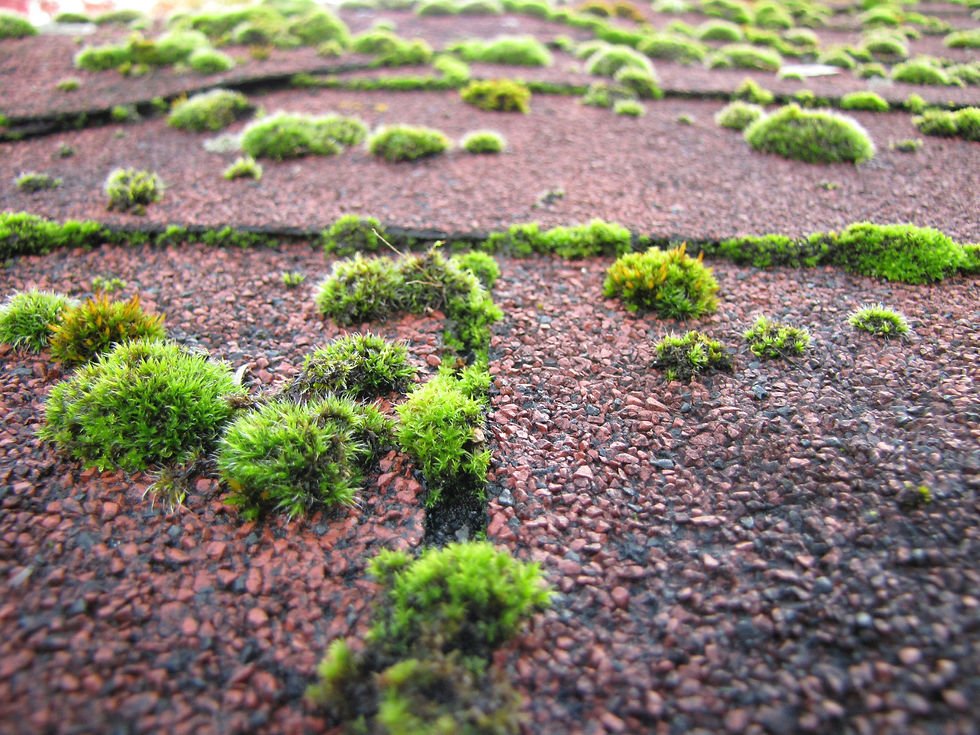
The Ancient Survivor
Mosses are bryophytes, among the first plants to leave the water and colonise land, and they have changed remarkably little since. They have no roots, no internal plumbing and no seeds. They take up water and nutrients directly through their leaves, which are often a single cell thick, and they can dry out completely, sit dormant through a drought, and revive within minutes of the next rain.
That ability to switch on and off with the weather is what makes them so well suited to a British roof, which is wet for long enough to grow them and dry for long enough to kill almost anything else.
The Micro-Anchors
In place of roots, moss produces rhizoids: fine, thread-like filaments whose only job is to hold on. They do not draw water. They find the texture of a concrete tile, the weathered face of a clay one, the sand in a mortar joint or the gap between two paving blocks, and they grip.
The rougher and more porous the surface, the better the anchorage, which is why an older concrete roof that has lost its factory finish carpets over so much faster than a new one, and why the north slope, which dries slowest, always goes first.
The Sponge Effect
A moss cushion is a water store. It holds many times its own dry weight in rain and releases it slowly, which is exactly what the plant wants and exactly what the roof does not. The tile beneath a moss cushion is wet for days after the rest of the roof has dried, and a chronically wet tile is where frost damage, further colonisation and mortar decay all begin.
There is a second consequence that costs more homeowners money than any other. Moss sheds. Cushions break away in wind and heavy rain, slide down the slope and land in the gutter. The overwhelming majority of blocked gutters, overflowing downpipes and damp patches at the top of an external wall trace back to a roof that is shedding moss.
The Winter Threat: Cryofracture
Water expands by around nine per cent when it freezes. Water held in the pores of a tile or a mortar bed by a moss cushion freezes there, expands there, and pushes the material apart from the inside. One cycle does little. A British winter delivers dozens, and the cumulative result is a tile face that flakes, a mortar joint that crumbles, and eventually a tile that lets water through.
Thick growth along the lower edge of a tile can also lift it slightly from the one below, opening the lap that keeps wind-driven rain out. Moss does not need to break a roof to make it leak. It only needs to hold it open.
The Danger of Scraping
Scraping a roof feels productive and achieves the opposite. It removes the cushion and leaves the rhizoids and countless small fragments behind, and moss regenerates readily from fragments. A scraped roof is a roof that has just been propagated. It also puts a person on a fragile, wet, sloping surface, which is where a great many avoidable accidents happen.
Pressure washing a roof is worse again. It forces water up under the tile laps and into the roof space, strips the surface of concrete tiles, and drives moss fragments into every joint on the way down.
The Eradication Protocol
The bulk is removed gently, by hand or soft brush from safe access, working with the slope rather than against it. The roof is then treated with an approved biocide that reaches the rhizoids the brush could not, and the residual growth is left to die and weather away naturally over the following months rather than being forced off.
The gutters are cleared afterwards, because a moss treatment that leaves the downpipes full has only moved the problem. And the interval to the next treatment is set by the roof's aspect, pitch and tree cover, not by a date on a calendar.
Bryophyte Ecology
The MS-Code details the ecology of non-vascular land plants (Bryophytes) that colonize the upper elevations of the built environment. Mosses lack traditional root systems; instead, they utilize microscopic rhizoids to anchor deeply into the porous structure of roof tiles, brickwork, and block paving.
Hydraulic Loading & Cryoclasty
The primary danger of moss is its biological architecture, which is engineered to retain water. A moss colony acts as a massive thermal and hydraulic sponge on your roof. During winter months, this trapped moisture undergoes cyclical freezing and expanding (cryoclasty), which slowly fractures and spalls the substrate.
Scraping and The Hydra Effect
Relying solely on mechanical scraping to remove moss is a temporary illusion. While the bulk biomass is removed, the microscopic rhizoids remain entrenched in the tile. When exposed to subsequent rainfall, these rhizoids rapidly regenerate, causing the moss to return thicker and faster—a phenomenon known as the Hydra Effect.
Biostatic Neutralization
Our stewardship protocol requires complete biological neutralization. After carefully manually clearing the macroscopic growth, we saturate the substrate with an M-Code compliant biostatic wash. This penetrates the pores, actively dissolving the remaining rhizoids and rendering the surface hostile to new spore germination.
Roofing Load Mitigation
A heavily mossed roof holds a surprising amount of water, and the moss that sheds from it blocks gutters and downpipes. Clearing and treating the growth lets the roof dry properly and shed rainwater into the guttering as it was designed to.
Inspecting from the Ground
Most roofs can be assessed safely from the ground, with binoculars or a camera on an extending pole, which avoids walking on fragile tiles. Photographs taken this way show the extent of growth before work begins and the result afterwards.