

Driveway Pressure Washing Northampton
Residential · Driveway Pressure Washing & Post-Construction Clean
A newly extended driveway had been left carrying the building work that made it — cured concrete splash, tarmac transfer, silicone and oil. Cleared by hand and machine in full summer heat, deliberately without chemicals.
Clearing a Driveway After the Builders Left — Post-Construction Pressure Washing, Northampton
A newly extended driveway had been left carrying the building work that made it — cured concrete splash, tarmac transfer, silicone and oil. Cleared by hand and machine in full summer heat, deliberately without chemicals.
Residential · Driveway Pressure Washing & Post-Construction Clean
SW-CASE-PW-RES-002
Saturday, 27 July 2024
Extended residential driveway and hardstanding (non-listed)
Northampton · suburban residential · recently extended hardstanding
Coloured concrete block paving · kiln-dried sand joints
The Pathology
Most driveway cleaning deals with biology. This one barely did. The loading here was construction residue left behind by recent extension work: cured cementitious splash bonded into the block surface, transferred tarmac from the road, cured silicone, and hydrocarbon staining. Beneath it sat the ordinary layer of road silt and algal film. Cement is the difficult one — it does not sit on block paving, it cures into the surface texture and becomes part of it.
χ Drag Factor
χ — demonstrative: elevated (sealant depleted, open surface porosity following construction works)
Biomass / Taxon
Minor — algal film and road silt only; dominant loading was non-biological construction residue
Atmospheric Log
Mid-summer; ambient ~30°C; full sun, no shade; block surface temperature substantially above air temperature

The Method
Most driveway cleaning deals with biology. This one barely did. The loading here was construction residue left behind by recent extension work: cured cementitious splash bonded into the block surface, transferred tarmac from the road, cured silicone, and hydrocarbon staining. Beneath it sat the ordinary layer of road silt and algal film. Cement is the difficult one — it does not sit on block paving, it cures into the surface texture and becomes part of it.
There is a sentence worth saying before any driveway is cleaned, because it saves everyone a difficult conversation afterwards: cleaning is not sealing. They are two different jobs, with two different products and two different prices. A cleaned drive that has lost its sealant will look flat and dry when it is finished, because it is dry. The depth and colour saturation people remember came from a coating, and that coating is not something water puts back.
Block paving is usually sealed after laying. The sealant soaks into the top of the concrete, deepens the pigment and puts a slight sheen on it, and then it wears — under tyres, under UV, under frost — over roughly three to five years. Nothing about that is a fault. But once it has gone, the block underneath is a matt, porous, mineral surface, and matt porous mineral is exactly how it will look once it is clean.
This drive had a specific history. It had recently been extended and the house had been worked on, and the surface was carrying the evidence: cured concrete splash, tarmac dragged in from the road, silicone, and oil. That is a post-construction clean rather than a maintenance clean, and it is a different discipline. Maintenance cleaning removes what grew. Post-construction cleaning removes what someone else left, and most of it is harder than biology.
Cement is the difficult one. Algae sits on a surface and can be released chemically; cured cementitious splash does not sit on block paving at all — it cures into the surface texture and becomes mechanically keyed to it. There is no chemistry that removes it without also attacking the block, because the block is made of the same family of material. That leaves controlled mechanical removal, and nothing else.
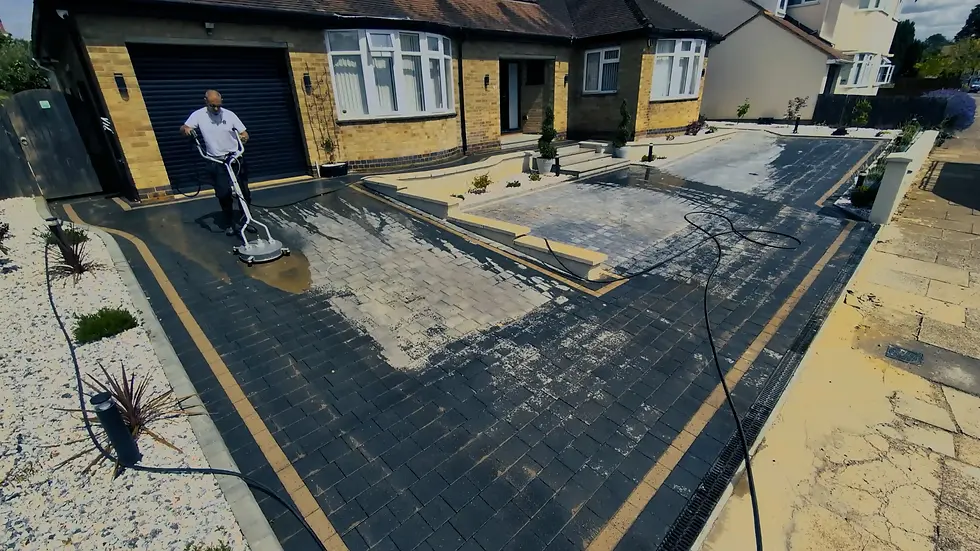
So the lance came out, which on block paving is always a judgement rather than a default. Held too long or too close it erodes the block face and strips jointing sand, and the damage is permanent. Used briefly, at distance, and only where cured cement left no alternative, it removes the deposit and leaves the block. The skill is entirely in knowing when to stop, and that is not something a machine setting can decide for you.
The other decision that day was not to use chemicals at all. It was around thirty degrees with no shade, and the block surface was considerably hotter than the air. Sodium hypochlorite on hot coloured concrete flash-dries before it has time to work, and what it leaves behind is bleaching and streaking that no second clean removes. On a coloured drive in full summer sun, the professional choice is to withhold the treatment, not to apply it carefully.
Not everything was difficult. The oil staining lifted with water alone — no solvent, no degreaser — which is more common than people expect on a porous block that has not been sealed for a while. The road silt and algal film released almost immediately. It is worth saying, because it cuts against the instinct that a bad-looking drive needs strong chemistry. Most of what makes a drive look bad is loose, and comes off with heat, flow and patience.
The finished drive was clear of everything that had been left on it, and flat in colour, because that is what an unsealed block drive looks like when it is genuinely clean. Restoring the depth is a sealing job — a separate visit, a separate product, and worth doing while the surface is clean and dry. Said before the work rather than after, it turns a disappointment into a plan.
This case study is a demonstrative model of our method and standards. It is not a price list; every driveway is assessed on its blocks, its history and its condition before any figure is discussed.
FAQ
Why does my driveway still look dry after it has been cleaned?
Because the sealant has gone. The depth and sheen come from a coating that soaks into the block and wears out over a few years. Cleaning removes what sits on the block; it cannot replace what has worn off it.
Can you remove cement or concrete splashes from block paving?
Usually, but mechanically rather than chemically. Cured cement keys into the block's surface texture and is the same family of material, so anything that dissolves it attacks the block too. It is careful, controlled lance work and it takes time.
Will you use chemicals on my driveway?
Only when conditions allow it. On hot coloured block in full sun, biocide flash-dries before it works and leaves permanent bleaching and streaking. On a day like that we withhold it rather than risk the surface — and say so at the time.
Can you clean and reseal on the same visit?
Not usually. Sealant needs a surface that is clean and properly dry, which normally means returning after the drive has had time to dry through. It is also a separate cost — cleaning and sealing are two jobs, not one with a finish.
My driveway is filthy after building work — is that a normal clean?
No, it is a different job. Post-construction residue — cement, tarmac, silicone, plaster — is bonded rather than grown, and needs mechanical work rather than chemistry. It takes considerably longer than a maintenance clean.
The RIsk To Your Asset
Two risks ran alongside each other. A lance is locally aggressive on concrete block: held too long or too close it erodes the block face and strips the jointing sand, and that damage does not come back. It was therefore used only where cured cement left no alternative. The second risk was chemical — biocide flash-drying on hot coloured block bleaches and streaks it permanently. On a thirty-degree day, declining to treat protects the drive more reliably than treating it carefully would have.
Cured cement · keyed into the block surface
Hot coloured block · biocide flash-dry and bleach
Material Substrate
No chemicals were used, and that was a decision rather than an omission. At around thirty degrees the block surface was hot enough to flash-dry sodium hypochlorite before it could work, risking bleaching and streaking on coloured concrete. The general area was cleared with a rotary surface cleaner to distribute the flow, and the cured concrete was removed with a lance — the only mechanical option for set cementitious material, used under close control and accepted as locally aggressive.
No chemicals · a deliberate, heat-driven decision
Lance only where cured cement left no alternative
Specification / Dataset
Substrate: coloured concrete block paving · kiln-dried sand joints
Loading: cured cementitious splash · tarmac transfer · cured silicone · hydrocarbon staining · road silt and algal film
Origin: construction residue from recent extension and hardstanding works
Conditions: mid-summer, ambient ~30°C, full sun, elevated block surface temperature
Chemistry: none applied — withheld on heat grounds
Method: rotary surface cleaner across the general area · lance under close control on cured cement only
Oil staining: lifted with water alone; no solvent or degreaser required
Condition finding: sealant depleted — resealing recommended as separate work
Figures: demonstrative — area, timings and re-clean interval to be field-captured
OUR PROTOCOL
Coloured concrete block paving · kiln-dried sand joints
BIOLOGICAL AGENT
Minor — algal film and road silt only; dominant loading was non-biological construction residue
SITE / ENVIRONMENT
Northampton · suburban residential · recently extended hardstanding
FORENSIC DETAIL
Most driveway cleaning deals with biology. This one barely did. The loading here was construction residue left behind by recent extension work: cured cementitious splash bonded into the block surface, transferred tarmac from the road, cured silicone, and hydrocarbon staining. Beneath it sat the ordinary layer of road silt and algal film. Cement is the difficult one — it does not sit on block paving, it cures into the surface texture and becomes part of it.
OUTCOME
Construction residue, tarmac and silicone were removed, and the oil staining lifted with water alone without any solvent or degreaser. The blocks were assessed as having lost their sealant, and resealing was recommended as separate work. Figures here are demonstrative — area, timings and re-clean interval to be field-captured.
Your Built Environment
Diverse solutions tailored to your every need

Browse the Shop & Pricing
See every service with clear, upfront pricing — no hidden quotes. Add what you need to your basket and book it in a few clicks, whenever it suits you.

Create & Manage Your Account
Register a free account to manage your services, see past visits and rebook in seconds. Everything about your property's care, in one place.

View the Calendar
See when we're free and choose a date that works for you. Prefer a tailored quote first? Tell us what you need and we'll come straight back.
Book These Services Directly Online






Explore how we restore and protect other residential, commercial, and heritage properties using our evidence-based methods.


