
North-Facing Patio Cleaning: Heavy Black Spot Removal
Residential · Patio Cleaning & Black Spot Treatment
A north-facing patio carrying dense, patchy black spot on slabs identical to the sound ones at the front of the same house. Treated section by section, and photographed honestly.
Every Photograph You See Is Wet — North-Facing Patio Cleaning
A north-facing patio carrying dense, patchy black spot on slabs identical to the sound ones at the front of the same house. Treated section by section, and photographed honestly.
Residential · Patio Cleaning & Black Spot Treatment
SW-CASE-PW-RES-007
Sunday, 13 May 2018
Residential side-return patio (non-listed)
North-facing side return · walled and fenced · restricted direct sun, slow drying
Riven-faced pigmented concrete paving slabs · buff/honey · butt joints
The Pathology
Aspect did all of this. The same house, the same slabs and the same age — and the front, which faces the sun, needed minutes. This side faces north, sits between a wall and a fence, and dries hours later than the front after every rainfall. That extra wet time is the whole difference. Dense crustose black spot lichen had taken the slab faces in patches rather than as an even sheet, with green algal film between and light moss along the joints.
χ Drag Factor
χ — demonstrative: high on the north aspect, low on the south-facing front of the same property
Biomass / Taxon
Dense crustose black spot lichen · green algal film · light moss at slab margins
Atmospheric Log
North-facing aspect; restricted direct sun; extended surface wetness compared with the south side of the same dwelling
The Method
Aspect did all of this. The same house, the same slabs and the same age — and the front, which faces the sun, needed minutes. This side faces north, sits between a wall and a fence, and dries hours later than the front after every rainfall. That extra wet time is the whole difference. Dense crustose black spot lichen had taken the slab faces in patches rather than as an even sheet, with green algal film between and light moss along the joints.
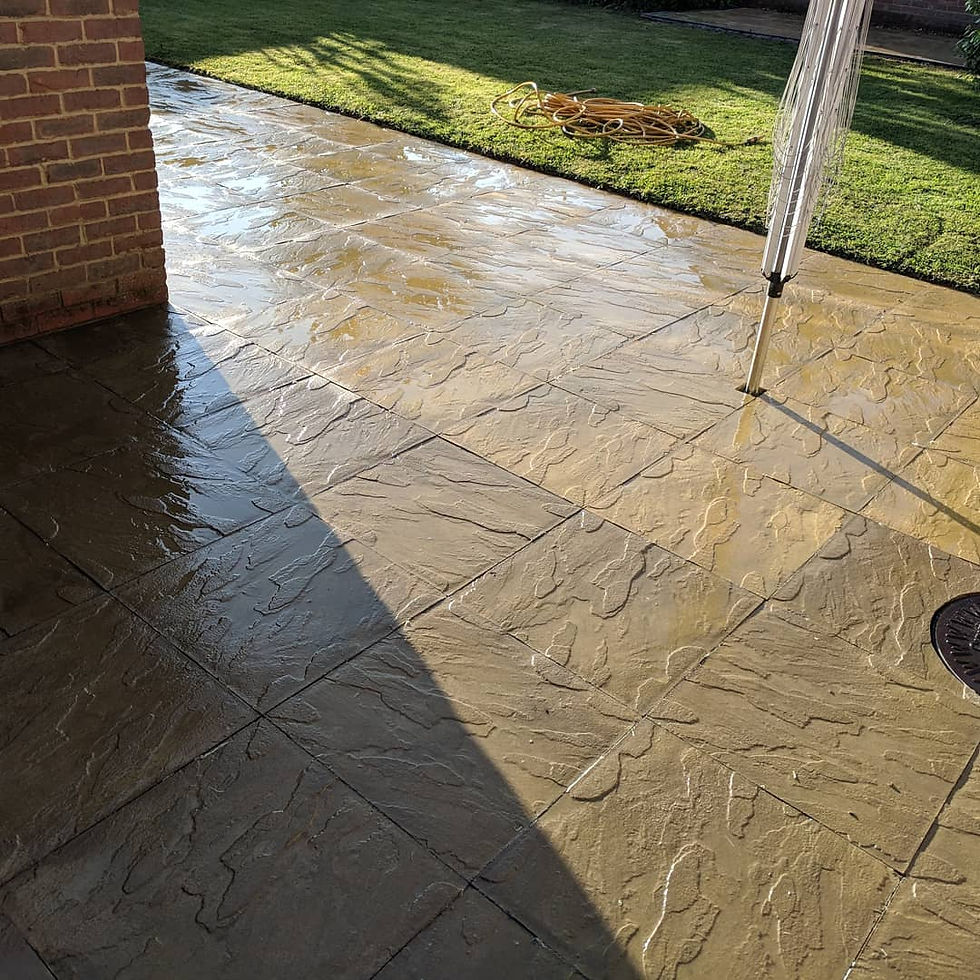
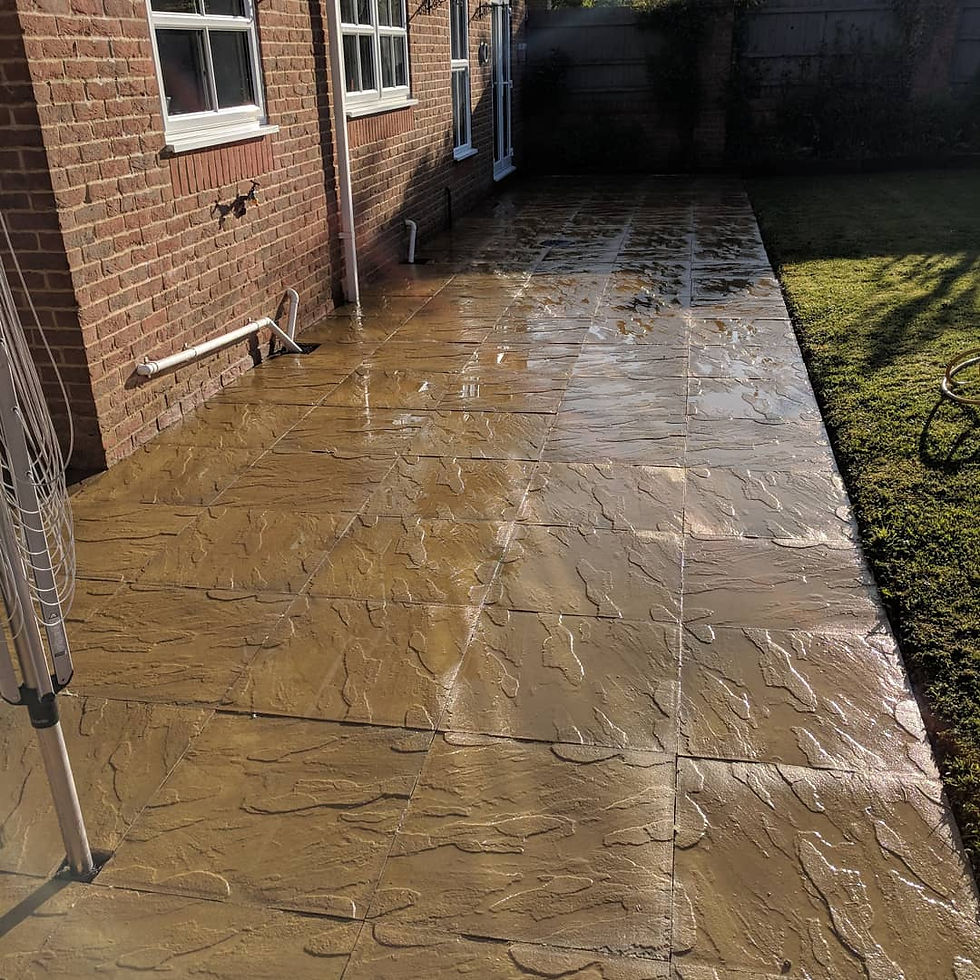
Start with the thing nobody in this trade says out loud: the photographs are wet. Every before-and-after you have ever scrolled past, including the ones further up this page, was taken while the surface was still soaked — because wet stone is saturated stone, the colour goes deep, the contrast doubles, and the result looks perhaps a third better than it will look on Tuesday. This patio dried and went quieter. It was still an excellent result. It was not the photograph.
We photograph wet because that is when we are standing there with the kit in the van and the light still good, and because it is genuinely the moment the work looks like what it felt like. But if a contractor shows you only soaked surfaces and never says why, they are letting an optical effect do some of the selling. So: expect your patio to look like the wet picture for about an hour, and like a good version of itself after that. Anyone promising otherwise is selling a sealant and has not mentioned it yet.
As for why this patio and not the other one — it was the north side, and that is almost the entire explanation. The front of the same house, the same slabs, laid at the same time by the same people, took a few minutes. This side sits between a wall and a fence facing away from the sun, so after rain it stays wet for hours longer than the front does. Colonisation is not a function of neglect or of how much traffic a surface gets. It is a function of how long the surface stays damp, and aspect decides that.
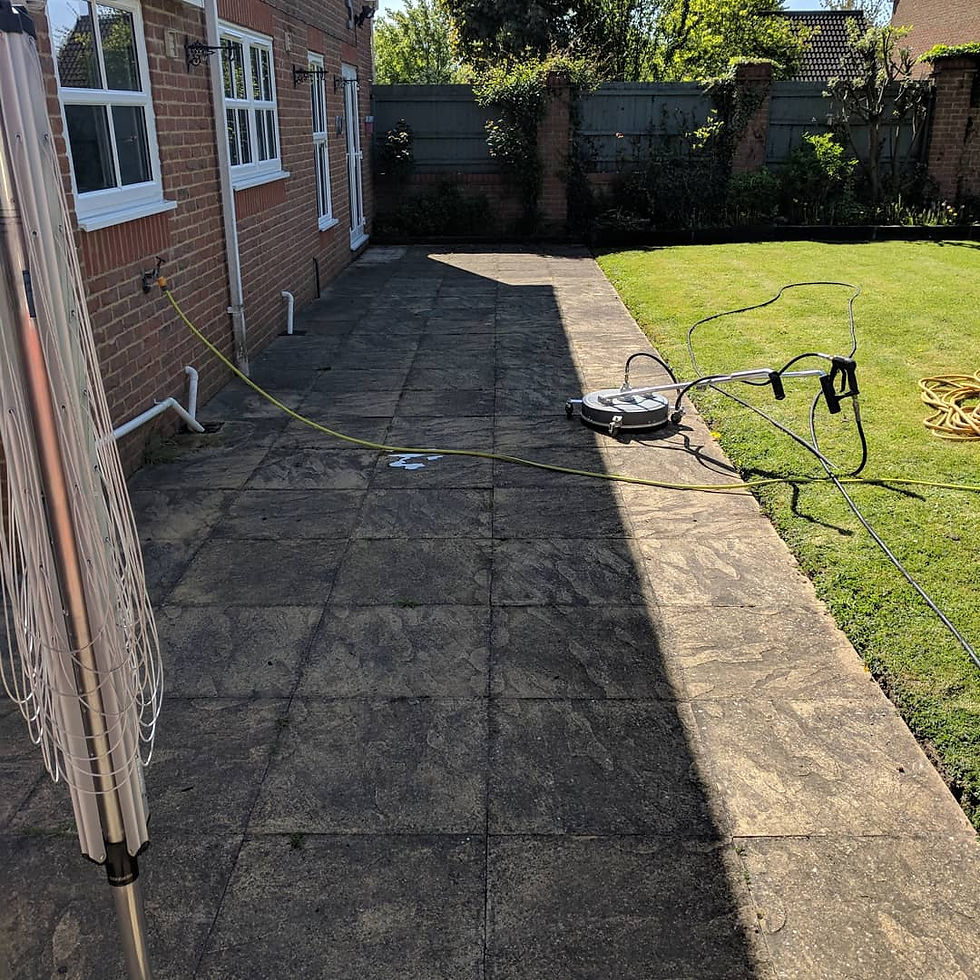
The black spot here was not a sheet, it was a population — discrete colonies scattered dense across the whole area, some the size of a five-pence piece, some merged into patches. That changes the work completely. A uniform film you can treat in passes. Colonies have to be met individually, worked, and in places revisited, because the treatment only does anything where it actually lands and stays. Which is why this took the afternoon rather than the hour somebody estimating it from a photograph would have allowed.
This is the honest reason surfaces like this are hard to quote. With window cleaning you can be genuinely accurate — a given house, a given number of panes, and experience closes the gap to a few minutes either way. A colonised patio has two variables that do not behave: the area, which you can measure, and the density and maturity of what is growing on it, which you cannot, not reliably, not from the pavement and sometimes not until the first section is done.
Which leads somewhere uncomfortable about how this industry is organised. Take an eight-hour day and put fifteen jobs on it and you have thirty-two minutes per job including the drive between them. Put twenty on and you have twenty-four. I have seen worksheets like that. Nobody on one of those sheets is dwelling a treatment for an hour or working a lichen colony twice, not because they are bad at the work but because the arithmetic has already decided what they are allowed to do. Splash and dash is not a character flaw. It is a schedule.
There is one more variable and it is the one nobody puts in writing: the tradesman. I am not twenty any more, and I have physical health conditions, so the pace I work at is a chosen one rather than a maximum one. That is not an apology. Work done at a sustainable pace on a surface like this is better work — steadier passes, more attention paid to the patches that need it, fewer decisions made because the light is going. A trade that treats speed as the only measure of competence ends up with neither.
This one did not begin well, either. I was late, because one job had run into the next, which is the commonest reason any tradesman is late and the least often believed. What I got on the phone, and again on arrival, was rudeness of a sort I do not accept any more. So I said so, calmly, and offered the choice: the conversation changes or I go. It changed. Her husband, meanwhile, apologised, moved everything off the patio himself, and could not have been more decent about any of it.
When it was done he came out and said “wow”. Then apologised again, then said it a second time. That is the entire review and I have never needed a better one. It is also why the job got finished, because a household is not one person and none of it was his fault. Setting a boundary at the start is what made the rest of the afternoon possible — and the afternoon is what the photographs are of.
This case study is a demonstrative model of our method and standards. It is not a price list; every patio is assessed on its aspect, its substrate and the density of what is growing before any figure is discussed.
FAQ
Why is one side of my house so much worse than the other?
Aspect. A north-facing surface stays wet for hours longer after rain than a south-facing one, and wet time is what decides whether anything can colonise. Same slabs, same age, entirely different condition — it is the commonest thing we see.
Will my patio look like the photograph?
For about an hour. Cleaning photographs are taken on a wet surface, which saturates the colour and roughly doubles the contrast. Dry, it settles to a quieter version of the same result. We would rather say that than let you find out on Tuesday.
Why can't you give me a fixed price from a photograph?
Because area is measurable and colonisation density is not. Scattered lichen colonies have to be treated individually and sometimes twice, so two patios of identical size can differ by hours. We will quote on a range and explain what moves it.
Why does a patio clean take so long?
Because most of it is dwell time and detail. The treatment has to stay wet on the surface to work, and dense black spot has to be met colony by colony. A job done in thirty minutes has skipped both, and it will show within a season.
How often will a north-facing patio need doing?
More often than a sunny one on the same property, which surprises people. We would rather set a shorter, gentler interval on the shaded side than let it reach the point where heavy intervention is the only option left.
The RIsk To Your Asset
Dense lichen tempts you into force, and force on a riven slab is worse than on a flat one — the moulded texture means the jet cannot sit at a constant distance, so the raised detail takes far more energy than the hollows and wears off first. You end up with a patio that is clean and subtly flattened, and nothing puts the texture back. The aspect that caused the problem also outlasts the clean: a north-facing surface will recolonise faster than a south-facing one on the same property, so the honest plan is a shorter interval here than elsewhere, not a harder clean.
Patchwork black spot · treated individually, not broadcast
North aspect · the same slab, a different problem
Material Substrate
Sodium hypochlorite applied and allowed to dwell, then worked patch by patch rather than broadcast across the whole area — with dense individual spotting, the treatment has to meet each colony rather than pass over it, and that is what took the time. Adjacent lawn and planting soaked with clean water beforehand and rinsed afterwards. Rotary flat surface cleaner across the field once the growth had released, lance at distance to the edges and the wall line.
Time on the surface · not speed across it
Result judged dry · not wet
Specification / Dataset
Substrate: riven-faced pigmented concrete paving slabs · buff/honey · butt joints
Aspect: north-facing side return, enclosed by wall and fence — the controlling variable
Control comparison: south-facing front patio and steps at the same property, same slabs, sound condition, minutes to clean
Colonisation: dense crustose black spot lichen in discrete colonies · green algal film · light joint moss
Treatment: sodium hypochlorite, dwelled, then worked colony by colony rather than broadcast
Pre-protection: adjacent lawn and planting saturated with clean water before application
Mechanical: rotary flat surface cleaner across the field once growth had released · lance at distance to edges and wall line
Duration: approximately two hours on the surface
Reinstatement: planting rinsed again on completion
Figures: demonstrative — area, product volume and dwell to be field-captured
OUR PROTOCOL
Riven-faced pigmented concrete paving slabs · buff/honey · butt joints
BIOLOGICAL AGENT
Dense crustose black spot lichen · green algal film · light moss at slab margins
SITE / ENVIRONMENT
North-facing side return · walled and fenced · restricted direct sun, slow drying
FORENSIC DETAIL
Aspect did all of this. The same house, the same slabs and the same age — and the front, which faces the sun, needed minutes. This side faces north, sits between a wall and a fence, and dries hours later than the front after every rainfall. That extra wet time is the whole difference. Dense crustose black spot lichen had taken the slab faces in patches rather than as an even sheet, with green algal film between and light moss along the joints.
OUTCOME
The riven slab faces came back to their buff colour with the patterning legible again, and the black spot cleared to a degree the owner described in a single word. Roughly two hours on the surface. The adjacent lawn is intact in the finished photographs. Area and dwell demonstrative pending field capture.
Your Built Environment
Diverse solutions tailored to your every need

Browse the Shop & Pricing
See every service with clear, upfront pricing — no hidden quotes. Add what you need to your basket and book it in a few clicks, whenever it suits you.

Create & Manage Your Account
Register a free account to manage your services, see past visits and rebook in seconds. Everything about your property's care, in one place.

View the Calendar
See when we're free and choose a date that works for you. Prefer a tailored quote first? Tell us what you need and we'll come straight back.
Book These Services Directly Online






Explore how we restore and protect other residential, commercial, and heritage properties using our evidence-based methods.


