
Patio Cleaning Service
Residential · Patio Cleaning & Biocidal Pre-Treatment
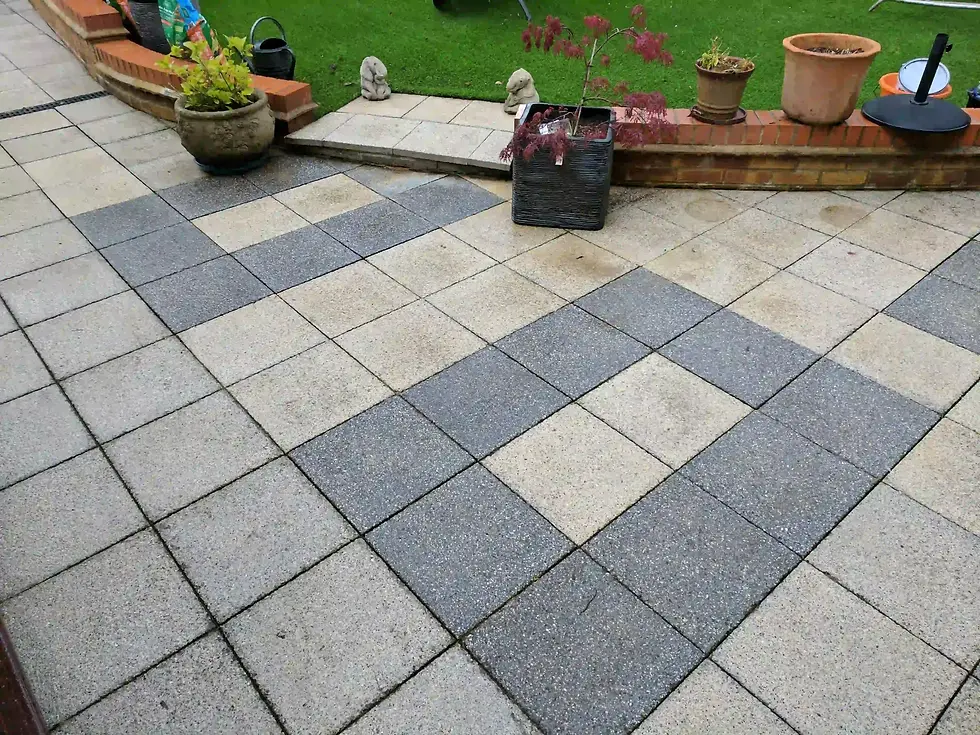
A patio had gone so uniformly dark that its owner had stopped seeing it as a patio. Underneath the colonisation sat a two-tone chequerboard, entirely intact, which nobody had looked at in years.
The Pattern Was Still There — Patio Cleaning Service
A patio had gone so uniformly dark that its owner had stopped seeing it as a patio. Underneath the colonisation sat a two-tone chequerboard, entirely intact, which nobody had looked at in years.
Residential · Patio Cleaning & Biocidal Pre-Treatment
SW-CASE-PW-RES-004
Thursday, 27 April 2017
Residential rear patio (non-listed)
Enclosed rear garden · fenced and walled on two sides · limited sun, slow drying
Exposed-aggregate concrete paving slabs · open sand joints
The Pathology
This was living colonisation, layered. A green algal film held in the surface porosity, a darker cyanobacterial crust over it, crustose black spot lichen bedded into the slab face, and moss packed into the open joints. Exposed-aggregate concrete is unusually receptive to all of it — porous, rough, water-retaining — and the enclosure made it worse, because fencing and walls on two sides slow the airflow that would otherwise dry the surface. Surface wetness duration, not dirt, is what decides how far this goes.
χ Drag Factor
χ — demonstrative: high (enclosed aspect, extended surface wetness, mature colonisation)
Biomass / Taxon
Green algal film · dark cyanobacterial crust · crustose black spot lichen · moss in joints
Atmospheric Log
Sheltered enclosure; restricted airflow; prolonged post-rainfall surface wetness


The Method
This was living colonisation, layered. A green algal film held in the surface porosity, a darker cyanobacterial crust over it, crustose black spot lichen bedded into the slab face, and moss packed into the open joints. Exposed-aggregate concrete is unusually receptive to all of it — porous, rough, water-retaining — and the enclosure made it worse, because fencing and walls on two sides slow the airflow that would otherwise dry the surface. Surface wetness duration, not dirt, is what decides how far this goes.
The thing worth looking at here is not how dirty it was. It is that the patio underneath turned out to be a two-tone chequerboard with a pattern set into the middle of it, and by the time we arrived nobody in the house could have told you that. They had not forgotten in the sense of misremembering. The information had simply stopped being available. You cannot recall a detail you have not been able to see for several years.
That is the part people find hardest to believe about biological colonisation: it does not make a surface patchy, it makes it uniform. A stain has edges. A colonising film does not — it spreads to fill whatever is habitable, and on a patio that is the whole thing. So the buff slabs and the charcoal slabs converged on the same flat grey, the contrast went, and the design went with it. The patio had not been damaged. It had been overwritten.
Which brings up the reason we pre-treat at all, and it is not the reason most people assume. Pressure alone will absolutely make a patio look clean. What it removes is the visible layer, and what it leaves behind is the base — the lichen thallus bedded in the slab face, the algal cells down in the porosity, the spores in the joint. Those are the parts doing the reproducing. Clean without treating and the surface looks excellent in June and familiar again by the following spring.
Here is the part that sounds backwards and is the whole argument. A pre-treated patio needs less pressure, not more. Living, anchored biomass grips; oxidised, dead biomass lets go. Once the chemistry has done the killing, the slabs release at a fraction of the force they would otherwise demand — which means the fine material around the aggregate stays where it is. Used properly, the chemical is not the aggressive step. It is what makes the mechanical step gentle enough to be safe.
There is also a small change to the usual order that makes a large difference. Common practice is to let the solution dwell and then take the rotary cleaner straight over the top of it, which means the machine is driving neat chemical across the slabs and throwing it into the air in front of whoever is holding it. We rinse first and machine second, so the cleaner is working through a diluted solution rather than a concentrated one. Same dwell, same result, considerably less of it airborne and less of it in whatever runs off.
It does have limits, and black spot is where you meet them. That is a crustose lichen, not a mark: a living thing with a body grown into the top millimetre of the slab, which is exactly why scrubbing does nothing and why it survives treatments that flatten everything else. Expect it to need a second application, sometimes a second visit, and expect a scatter of faint ghosts to remain. Anyone quoting on the basis that every spot will vanish has either not looked closely or is not telling you.
Then there is the question almost nobody in this trade will put in writing, which is where the water goes. It depends entirely on the pathway. Rinse onto open ground with no route to a gully or a watercourse, as here, and dilution and soil deal with it. Rinse onto a surface that runs to a street gully and it reaches a brook essentially as it left you, because a surface water drain is not connected to a treatment works. That second case is a pollution offence, which is why the pathway gets worked out before anything is mixed.
Where there is a pathway, the answer is barriers and a vacuum — stop it reaching the gully, recover it, take it away. And then you reach a genuinely unresolved problem the trade tends to talk around, which is that there is nowhere obvious to take it. Recovered wash water is a liquid, and a household waste centre will not accept liquids by the drum. Even sealed, unopened stock cannot go back to a supplier, because once it has left the site it cannot lawfully be resold. We are still establishing what the correct route actually is, and we would rather say that than pretend.
Protecting a garden is mostly done before the first drop of chemical is mixed. Every border, shrub and run of lawn gets soaked with clean water first, because a plant already full of water takes up very little of anything else, and because dilution at the leaf is worth more than caution at the sprayer. It reduces the risk substantially. It does not make it zero, which is why the planting gets rinsed again at the end and why some things get covered rather than trusted.
The post-treatment deserves stating plainly rather than slipping past. Leaving a light diluted pass on the clean surface to dry does extend how long it stays bright, because it deals with the spores that are already settling before you have packed the van. It is also a residue on a surface that children sit on and dogs walk across. So it is offered, explained, and given a re-entry interval — never applied quietly because it makes the result last longer and nobody asked.
There are three patios and drives in this collection now. On one we withheld the chemistry because the day was too hot and it would have bleached the blocks. On another the customer did not want it and got a plain water clean. On this one it was the right call and it was used properly. That is the actual point: it is a decision, made in front of the specific surface on the specific day, and a contractor who does the same thing everywhere is not making it.
One last note, on why you will read close to the opposite of much of this if you go looking. Ask the question today and you are handed a generated summary that reads like an answer from the search engine itself, assembled from whatever happens to rank — and what ranks is contractors reassuring each other on social posts and supplier blogs. It will tell you the chemistry breaks down into nothing but salt and water with no footprint. It largely does break down, and chloride really is a major end product; but where it meets organic matter it also forms chlorinated compounds the environmental literature records as persistent and toxic to fish. A comfortable half-truth, repeated often enough to be summarised back to you as fact. We would rather give you the version you can check.
This case study is a demonstrative model of our method and standards. It is not a price list; every patio is assessed on its substrate, its aspect and what is actually growing before any figure is discussed.
FAQ
Why does my patio need treating as well as washing?
Because washing removes what you can see and leaves what does the reproducing. The lichen and algae are rooted in the top millimetre of the slab. Treat the base and it stays clean for years; wash only, and it returns within a season.
Will the black spots come off completely?
Usually they fade a long way rather than vanish. Black spot is a crustose lichen growing into the slab itself, not a mark sitting on it. A second application shifts more, and a few faint ghosts often remain. We say so before quoting, not after.
Is the chemical safe around my plants and pets?
Everything adjacent is soaked with clean water beforehand, so a full plant absorbs very little, and rinsed again afterwards. That reduces the risk substantially rather than removing it. Pets and children are kept off until the surface has dried and been rinsed down.
Where does all the dirty water go?
That depends on the pathway, which we check first. On open ground with no route to a gully or watercourse, dilution and soil handle it. Where there is a route, we barrier it off and recover the water, because a surface water drain runs untreated to a brook.
Why do the joints need re-sanding afterwards?
Because cleaning removes the moss and takes some jointing sand with it, and that sand is what keeps the slabs bedded and stops weeds returning. It goes back once the surface has dried through — not the same day, or it simply washes out again.
The RIsk To Your Asset
Exposed-aggregate slabs carry their character in a thin layer of fine material around the stone. Hit that with concentrated pressure and it washes out, leaving the aggregate proud and the slab permanently coarser than its neighbours — and it cannot be put back. The joints are the second exposure: strip the sand and the slabs lose their bedding. The third is not on the patio at all. Where a site drains to a street gully or a watercourse, runoff reaches it untreated, and that is a pollution offence. Where there is no such pathway the calculation is entirely different — which is why the pathway gets identified before the sprayer comes out, not after.
Exposed aggregate · surface fines stripped by over-pressure
Discharge pathway · assessed before anything is mixed
Material Substrate
Furniture and pots cleared, joints and cracks checked. Surrounding planting and lawn saturated with clean water first, so any overspray meets an already-full plant. Cleaning solution applied at low pressure through a pump sprayer, never atomised through a high-pressure jet, and left to dwell ten to twenty minutes. The surface is then rinsed down before the rotary cleaner goes over it — so the machine works through a diluted solution rather than driving a neat one. Lance to the edges; joints re-sanded once dry.
Biocidal pre-treat · kills what pressure cannot reach
Rinse first, machine second · never over neat solution
Specification / Dataset
Substrate: exposed-aggregate concrete paving slabs · open sand joints · brick edging
Colonisation: green algal film · cyanobacterial crust · crustose black spot lichen · joint moss
Aspect: enclosed on two sides — restricted airflow, extended surface wetness
Pre-protection: all adjacent planting and lawn saturated with clean water before any chemistry
Pre-treatment: cleaning solution with surfactant, low-pressure pump sprayer, never atomised
Dwell: ten to twenty minutes
Sequence: rinse down first, then machine — the rotary cleaner works through a diluted solution, not a neat one
Mechanical: rotary flat surface cleaner across the field · lance to edges and returns
Pressure: moderate — reduced deliberately because pre-treatment removed the need for force
Discharge pathway: assessed before work — open ground with no route to a gully or watercourse on this site
Reinstatement: joints re-sanded once the surface had dried through
OUR PROTOCOL
Exposed-aggregate concrete paving slabs · open sand joints
BIOLOGICAL AGENT
Green algal film · dark cyanobacterial crust · crustose black spot lichen · moss in joints
SITE / ENVIRONMENT
Enclosed rear garden · fenced and walled on two sides · limited sun, slow drying
FORENSIC DETAIL
This was living colonisation, layered. A green algal film held in the surface porosity, a darker cyanobacterial crust over it, crustose black spot lichen bedded into the slab face, and moss packed into the open joints. Exposed-aggregate concrete is unusually receptive to all of it — porous, rough, water-retaining — and the enclosure made it worse, because fencing and walls on two sides slow the airflow that would otherwise dry the surface. Surface wetness duration, not dirt, is what decides how far this goes.
OUTCOME
The surface came back as a two-tone chequerboard in buff and charcoal, with the central motif legible again for the first time in years. Joint moss cleared and the sand replaced. Colonisation removed at the base rather than the surface, which is what decides whether it returns in a season or in years. Figures demonstrative.
Your Built Environment
Diverse solutions tailored to your every need

Browse the Shop & Pricing
See every service with clear, upfront pricing — no hidden quotes. Add what you need to your basket and book it in a few clicks, whenever it suits you.

Create & Manage Your Account
Register a free account to manage your services, see past visits and rebook in seconds. Everything about your property's care, in one place.

View the Calendar
See when we're free and choose a date that works for you. Prefer a tailored quote first? Tell us what you need and we'll come straight back.
Book These Services Directly Online






Explore how we restore and protect other residential, commercial, and heritage properties using our evidence-based methods.


