
Patio Slab Biocidal Treatment and Pressure Washing
Residential · Patio Slab Biocidal Treatment & Low-Pressure Wash
A patio the owner believed had gone ten years without a clean, carrying black spot, algae and moss. Treated rather than forced — and the terracotta pigment underneath turned out to be entirely intact.
Ten Years Under a Green Coat — Patio Slab Biocidal Treatment
A patio the owner believed had gone ten years without a clean, carrying black spot, algae and moss. Treated rather than forced — and the terracotta pigment underneath turned out to be entirely intact.
Residential · Patio Slab Biocidal Treatment & Low-Pressure Wash
SW-CASE-PW-RES-006
Saturday, 12 May 2018
Residential rear patio (non-listed)
Enclosed rear garden · hedged and planted boundary · restricted airflow, slow drying
Red/terracotta pigmented concrete paving slabs · open joints
The Pathology
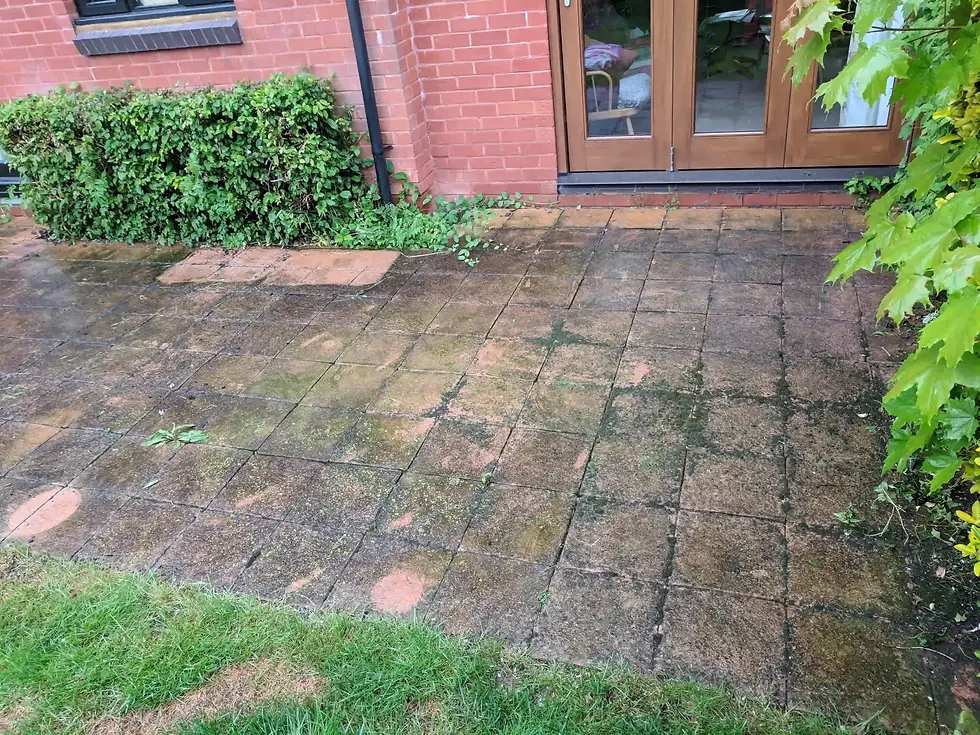
A decade of colonisation, layered and mature. Green algal film held across the slab faces, crustose black spot lichen bedded into the surface, and moss thickened through the joints and slab margins, with ground-cover growth advancing from the borders. The enclosure drove it: hedging and planting on two sides cut the airflow, so the surface stayed wet for hours after every rainfall. Surface wetness duration, not neglect in itself, is what allowed each stage to establish on the last.
χ Drag Factor
χ — demonstrative: very high (approx. decade-scale colonisation, enclosed aspect, sustained surface wetness)
Biomass / Taxon
Green algal film · crustose black spot lichen · moss in joints and slab margins · encroaching ground-cover growth
Atmospheric Log
Sheltered, hedged enclosure; restricted airflow; prolonged surface wetness after rainfall
The Method
A decade of colonisation, layered and mature. Green algal film held across the slab faces, crustose black spot lichen bedded into the surface, and moss thickened through the joints and slab margins, with ground-cover growth advancing from the borders. The enclosure drove it: hedging and planting on two sides cut the airflow, so the surface stayed wet for hours after every rainfall. Surface wetness duration, not neglect in itself, is what allowed each stage to establish on the last.
The owner reckoned it had been about ten years. That is the kind of thing people say slightly apologetically, as though a patio left alone is a moral failing rather than simply what happens when a garden is used for living in. What it actually meant was that we were not looking at dirt. We were looking at a mature ecological community that had had a decade to sort itself out, which is a different problem and, as it turned out, a more hopeful one.
There is an order to how these things arrive, and a decade is long enough to see the whole sequence. Algae comes first, because it asks for almost nothing — damp and light will do. Moss follows once there is enough trapped organic matter in a joint to root into. Lichen comes last and slowest, because lichens grow at a pace measured in millimetres per year, which is exactly why an established black spot population tells you more about elapsed time than any amount of surface grime does.
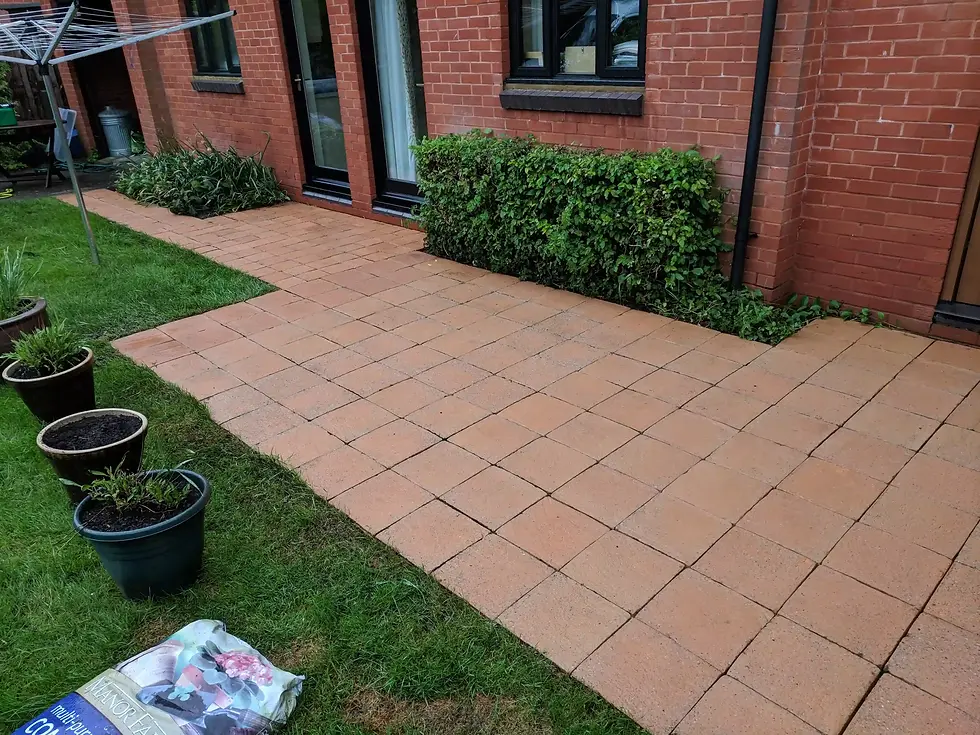
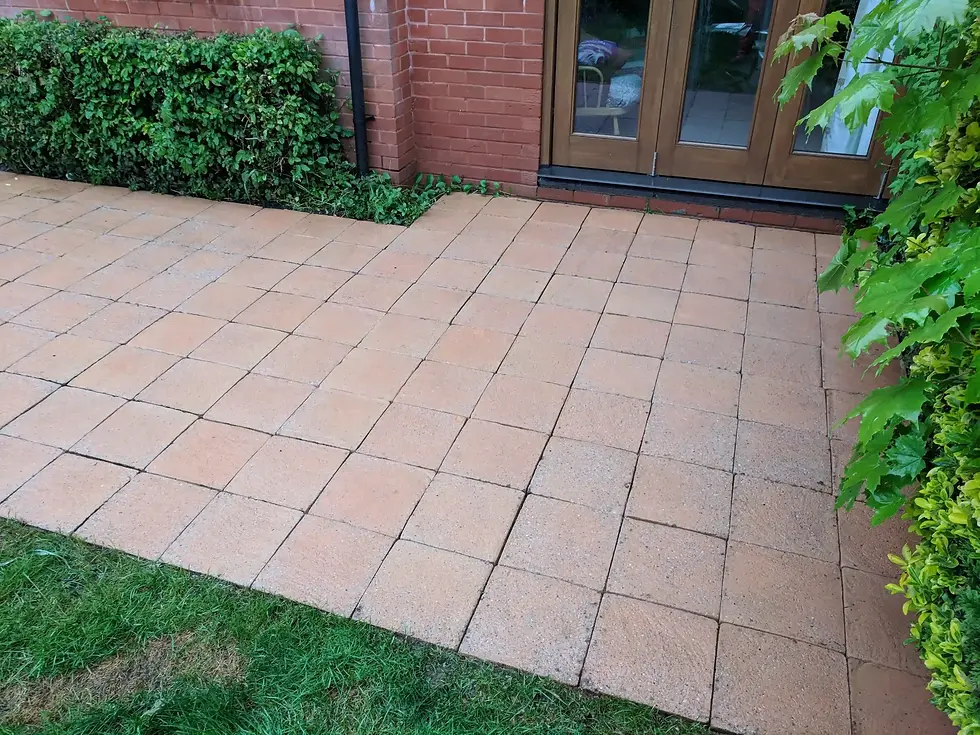
The thing people expect after ten years is damage, and that is not what was under it. The terracotta came back. The pigment was intact, the slab faces were sound, and the patio that emerged was recognisably the patio that had been laid — not a worn-out version of it. That surprises almost everyone, and it is worth sitting with, because it changes what neglect actually costs.
It is also a live argument in the literature rather than a settled fact, and we would rather say so. Whether a biofilm damages the stone beneath it or shelters it is genuinely contested — researchers have proposed weighing one against the other directly, and lichen thalli are described as capable of physically shielding a surface, an umbrella effect, as well as binding it. Which way it falls depends on the organism, the substrate and the conditions. On this patio the outcome was clearly benign. That is an observation about this job, not a general licence to leave things.
What it does mean practically is that a decade of neglect did not call for a decade's worth of force. The instinct is that the worse it looks, the harder you must hit it, and on pigmented concrete that instinct will cost you the colour you are trying to recover. So the pressure stayed low at both ends — a light wash first to take the loose surface dirt off, and a light rinse at the end. The chemistry did the lifting in between.
That hour in the middle is the part that gets skipped, and it is the part that actually works. The product is only active while it is wet; let the surface dry and it stops doing anything at all, quietly, without looking any different. So the hour is not waiting. It is an hour of keeping a whole patio uniformly damp, misting anything that starts to go off, and working the worst of the black spot by hand. That is time somebody has to be paid for, which is why it is the first thing to disappear from a cheap quote.
There is a step before the rinse that almost nobody mentions either. The treated surface is washed down with clean water to neutralise the cleaner before the pressure washer comes anywhere near it. Go straight in with the machine and you are atomising active chemical into the air around you, and around the garden. It costs a few minutes and it is the difference between a controlled job and a cloud.
Look at the lawn in the after photographs. It is green, whole, and shows no scorch or dieback anywhere along the edge — and that is not luck. Every border and run of grass was soaked with clean water before a drop of product was mixed, because a plant already full of water takes up very little of anything else, then rinsed again at the end. This stuff will kill vegetation if it is allowed to. The proof that it was handled properly is not a paragraph of reassurance; it is the grass still being there.
Which brings up the thing the search results will not tell you. Ask how to clean a patio like this and you will be handed a cheerful list that includes buying the trade-strength cleaner and doing it yourself. The manufacturer's own datasheet for the product we used says something different: severe skin burns and eye damage, very toxic to aquatic life, contact with acids liberates toxic gas, FFP3 respiratory protection, and in plain capitals, for use by professional operators. None of that is hidden — it is printed on the label. It simply does not survive the journey into a summary written to be encouraging.
This case study is a demonstrative model of our method and standards. It is not a price list; every patio is assessed on its substrate, its aspect and what is actually growing on it before any figure is discussed.
FAQ
My patio has not been cleaned in years. Is it too late?
Usually not. What looks like damage is normally a living layer sitting on a sound surface, and the slab underneath is often intact. We would rather assess it than assume — but long neglect on its own is not a reason to replace a patio.
Why does the treatment need to sit for an hour?
Because it only works while it is wet. Once the surface dries the product goes inactive, so the hour is spent keeping the whole area damp and misting anything that starts to dry off. Cut it short and you have paid for chemistry that never happened.
Why use chemicals instead of just more pressure?
Because pigmented slabs hold their colour in the surface layer, and enough force to shift mature lichen will take that colour with it. Treating first lets the growth release easily, so the wash can stay gentle. The chemistry protects the slab.
Will it kill my lawn and borders?
It can, which is why everything adjacent is soaked with clean water before anything is mixed and rinsed again afterwards. A plant already full of water takes up very little else. In this job's after photographs the lawn shows no dieback at all.
Can I just buy the same product and do it myself?
The manufacturer's datasheet says it is for use by professional operators, and lists severe skin burns, eye damage and high aquatic toxicity, with FFP3 respiratory protection required. That is on the label. We would rather you knew that than found out.
The RIsk To Your Asset
Pigmented concrete slabs hold their colour in the surface layer, so anything that erodes that layer takes the colour with it permanently — which is precisely the temptation on a patio this far gone, and precisely the wrong response. The second exposure is not the patio at all. A biocide strong enough to clear a decade of growth is strong enough to harm whatever it runs onto, so vegetation is soaked before and rinsed after, and the rinse is kept away from any route to a drain or watercourse. Neither of those steps is optional, and neither of them is visible in the finished photograph.
Decade-scale lichen · bedded into the slab face
Biocide runoff · vegetation soaked and rinsed
Material Substrate
Loose debris cleared, then a light pressure wash to take the surface dirt off so the treatment could reach what was actually living. Surrounding planting and lawn soaked with clean water. SmartSeal Patio Clean Xtreme applied by can to a pre-wetted surface, diluted one to one and used neat on the black spot, then kept continuously wet for a full hour — the product is inactive once dry. Neutralised with clean water first, then rinsed off at low pressure, with the planting rinsed again afterwards.
Chemistry did the lifting · pressure stayed low
Kept wet a full hour · dry product is dead product
Specification / Dataset
Substrate: red/terracotta pigmented concrete paving slabs · open joints
Colonisation: green algal film · crustose black spot lichen · joint and margin moss · encroaching ground cover
History: approximately ten years without cleaning — owner's estimate, recorded as given
Aspect: hedged and planted enclosure — restricted airflow, extended surface wetness
Stage 1: loose debris cleared · light pressure wash to remove surface dirt
Pre-protection: adjacent planting and lawn saturated with clean water
Product: SmartSeal Patio Clean Xtreme · chlorine-type active · applied by watering can to a pre-wetted surface
Dilution: 1:1 · used neat on black spot per manufacturer's direction
Dwell: 60 minutes, surface kept continuously wet — product inactive once dry
Stage 2: neutralised with clean water, then rinsed at low pressure · planting rinsed again
Figures: demonstrative — area, product volume and actual dwell to be field-captured
OUR PROTOCOL
Red/terracotta pigmented concrete paving slabs · open joints
BIOLOGICAL AGENT
Green algal film · crustose black spot lichen · moss in joints and slab margins · encroaching ground-cover growth
SITE / ENVIRONMENT
Enclosed rear garden · hedged and planted boundary · restricted airflow, slow drying
FORENSIC DETAIL
A decade of colonisation, layered and mature. Green algal film held across the slab faces, crustose black spot lichen bedded into the surface, and moss thickened through the joints and slab margins, with ground-cover growth advancing from the borders. The enclosure drove it: hedging and planting on two sides cut the airflow, so the surface stayed wet for hours after every rainfall. Surface wetness duration, not neglect in itself, is what allowed each stage to establish on the last.
OUTCOME
The slabs came back to their original terracotta with the pigment intact, and the joints cleared of moss. Some black spot needed working and a second pass. The adjacent lawn shows no scorch or dieback in the after images. Figures demonstrative — area, dwell and product volume to be field-captured.
Your Built Environment
Diverse solutions tailored to your every need

Browse the Shop & Pricing
See every service with clear, upfront pricing — no hidden quotes. Add what you need to your basket and book it in a few clicks, whenever it suits you.

Create & Manage Your Account
Register a free account to manage your services, see past visits and rebook in seconds. Everything about your property's care, in one place.

View the Calendar
See when we're free and choose a date that works for you. Prefer a tailored quote first? Tell us what you need and we'll come straight back.
Book These Services Directly Online






Explore how we restore and protect other residential, commercial, and heritage properties using our evidence-based methods.


