

Pressure Washing Service
Residential · Pressure Washing & Hardscape Restoration
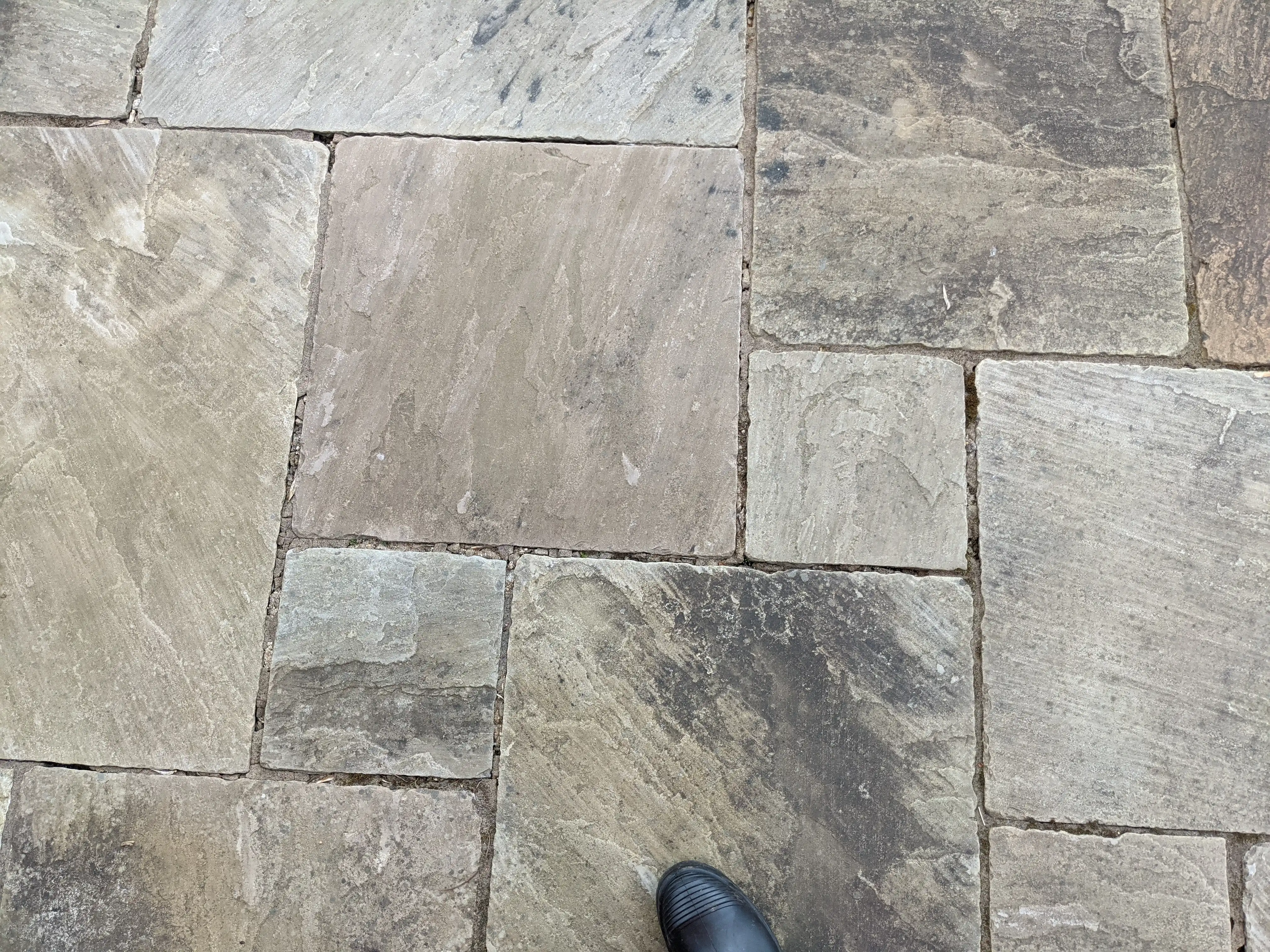
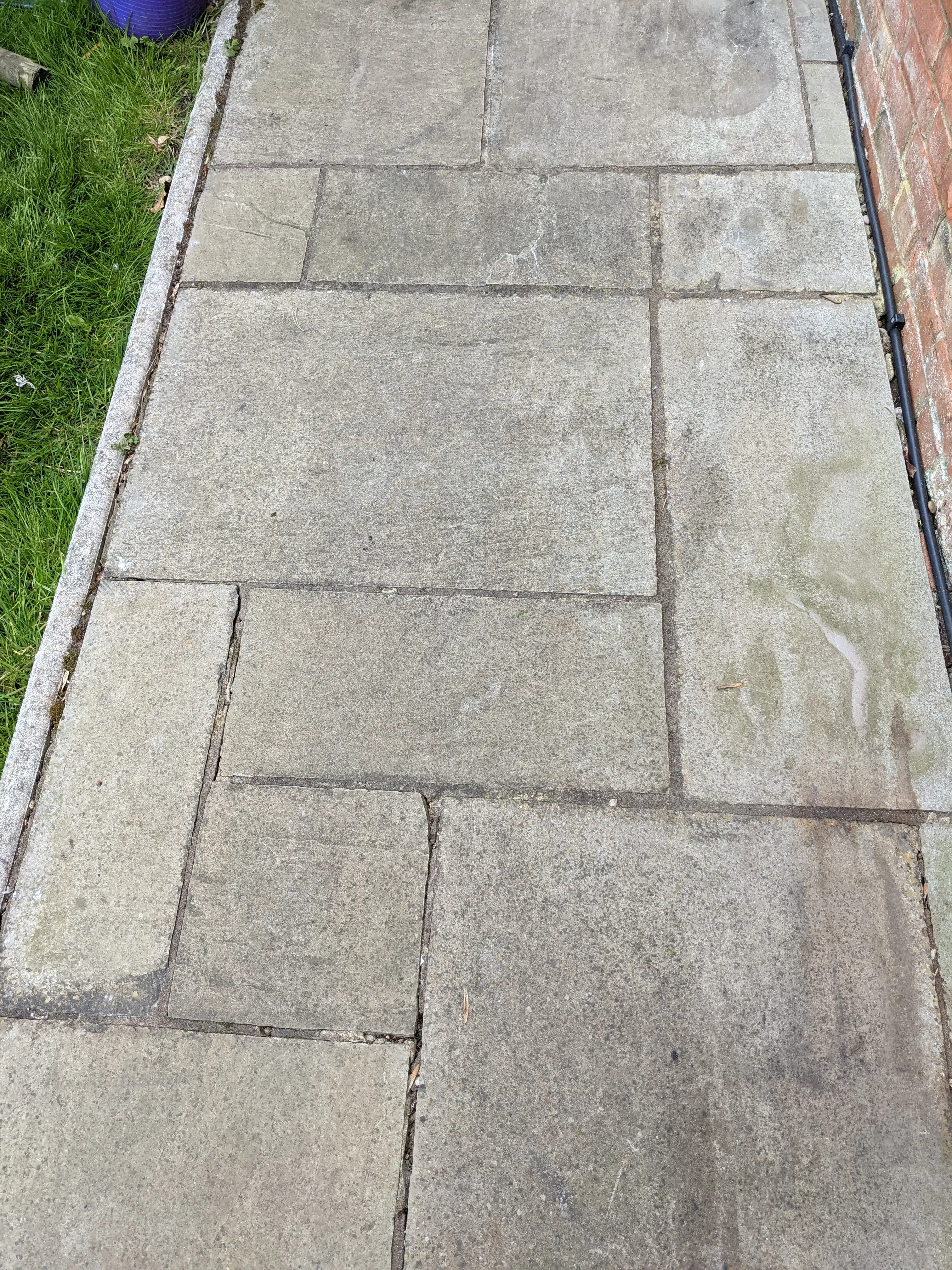
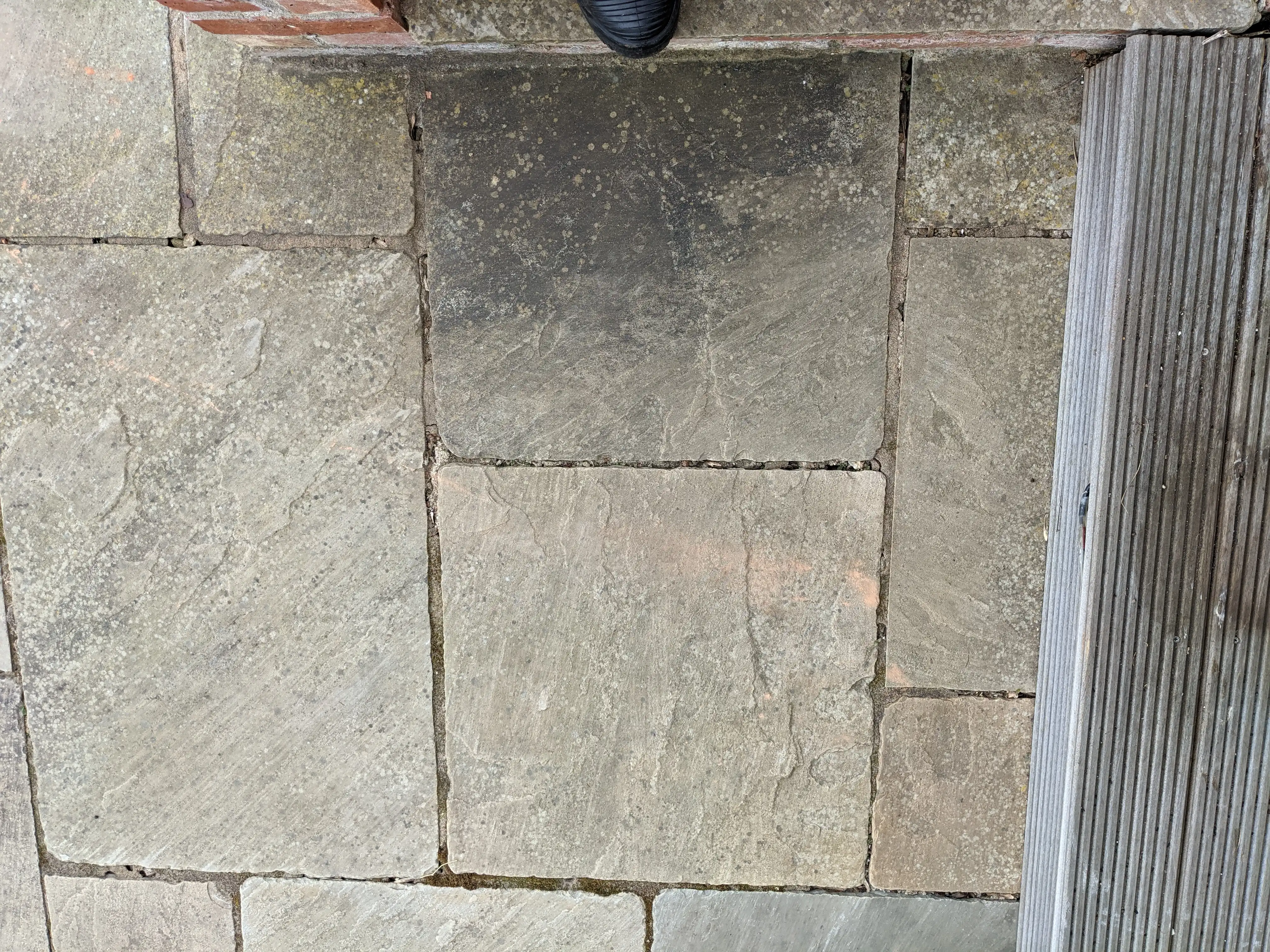
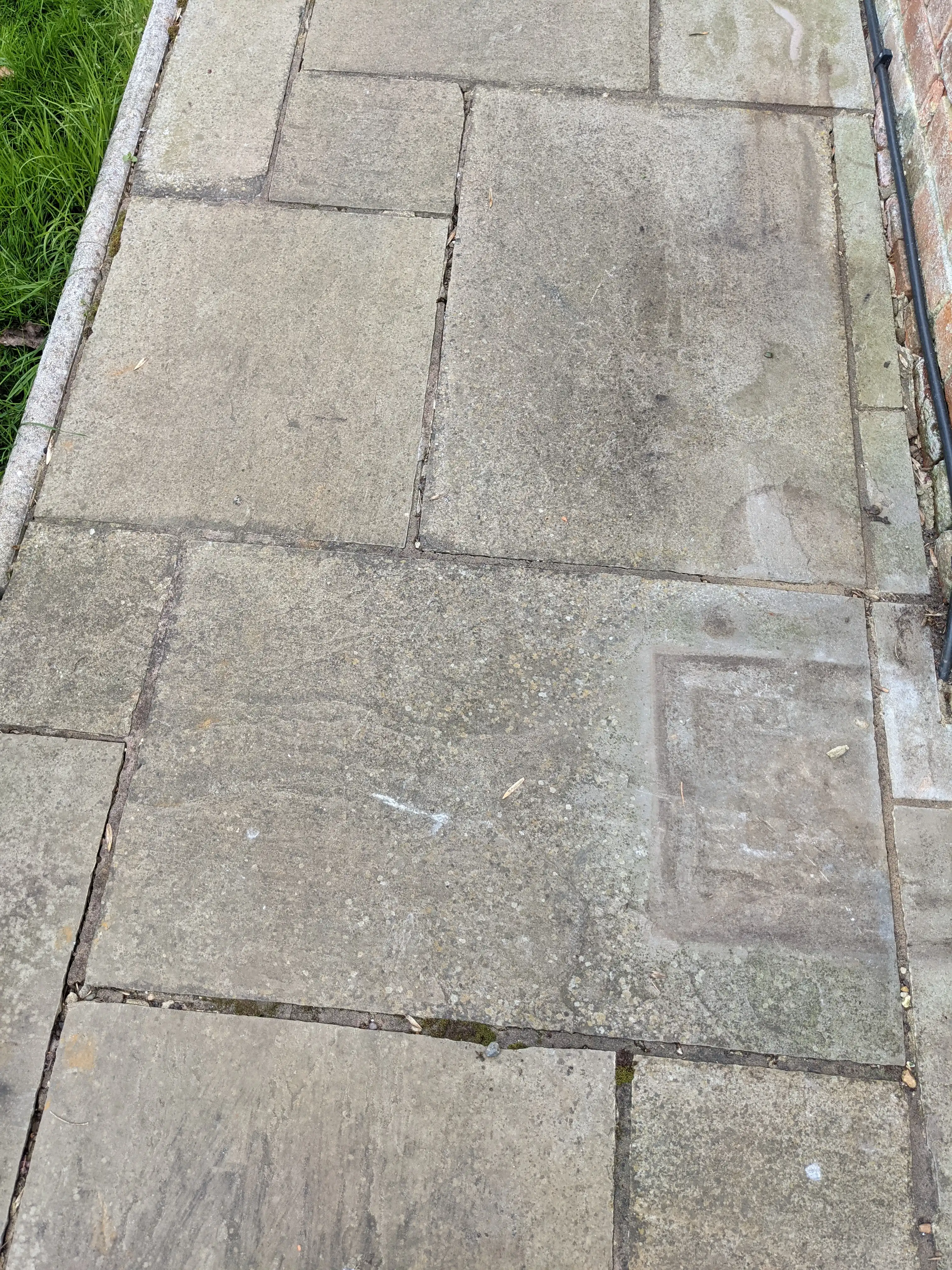
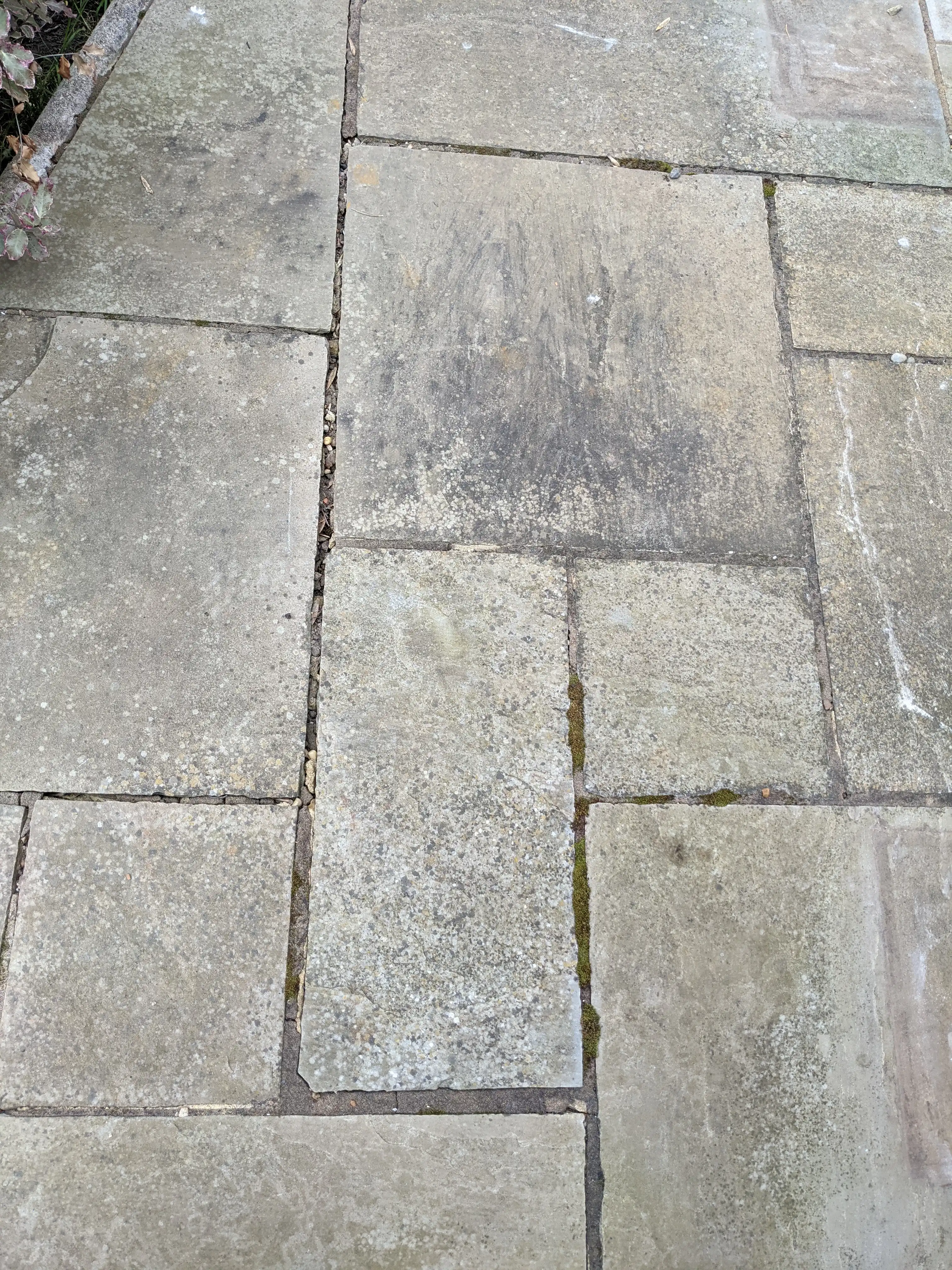
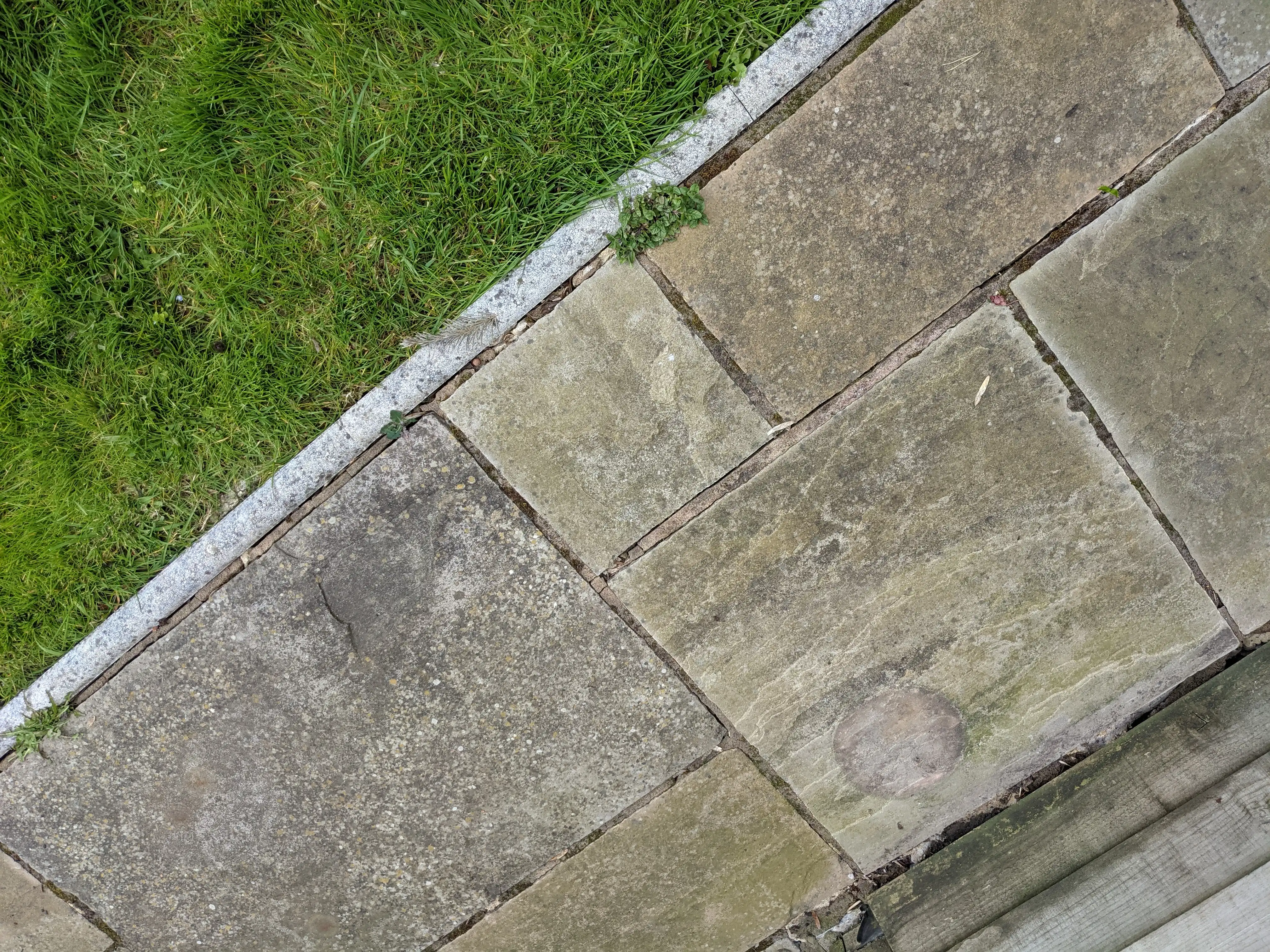
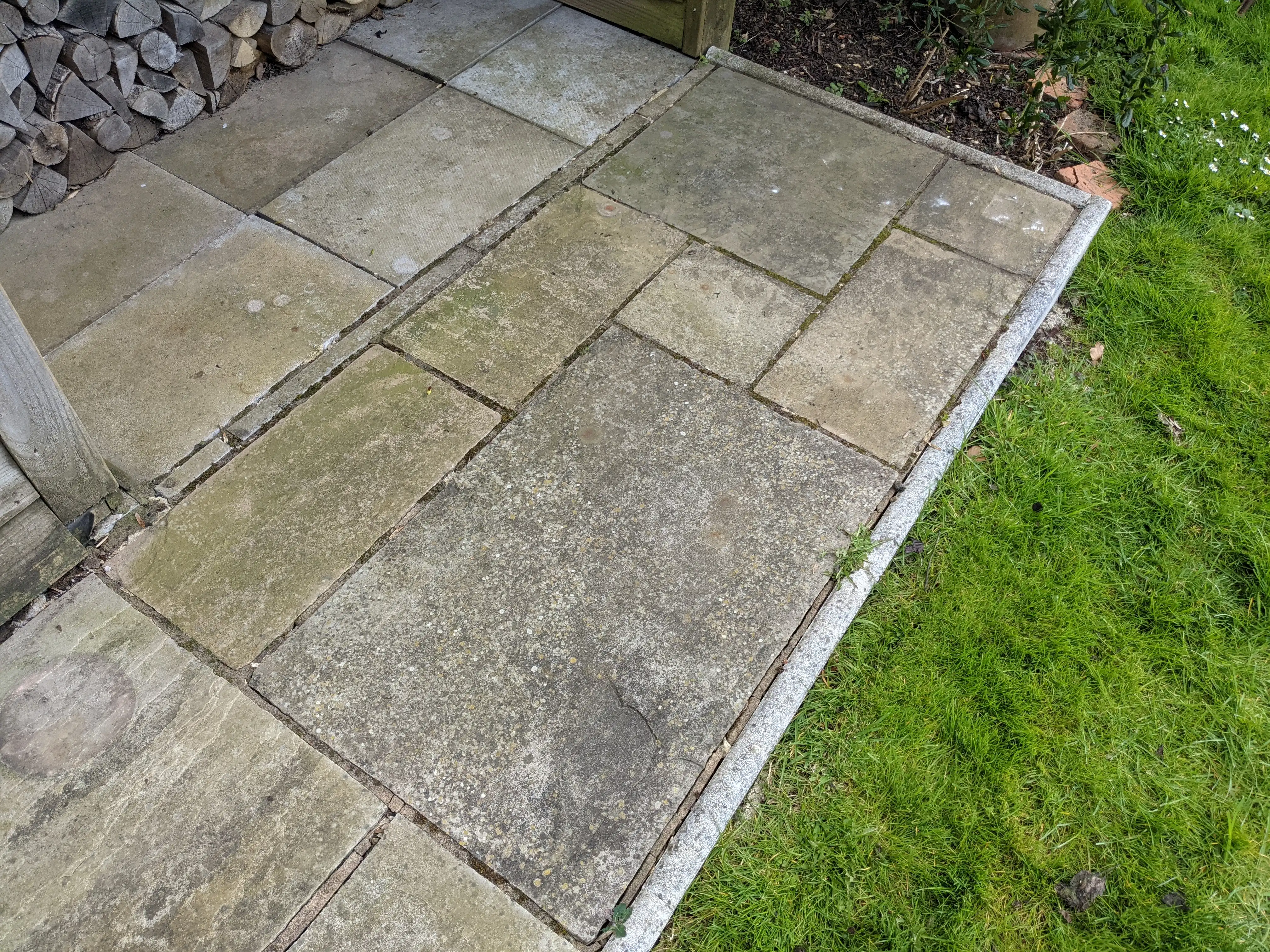
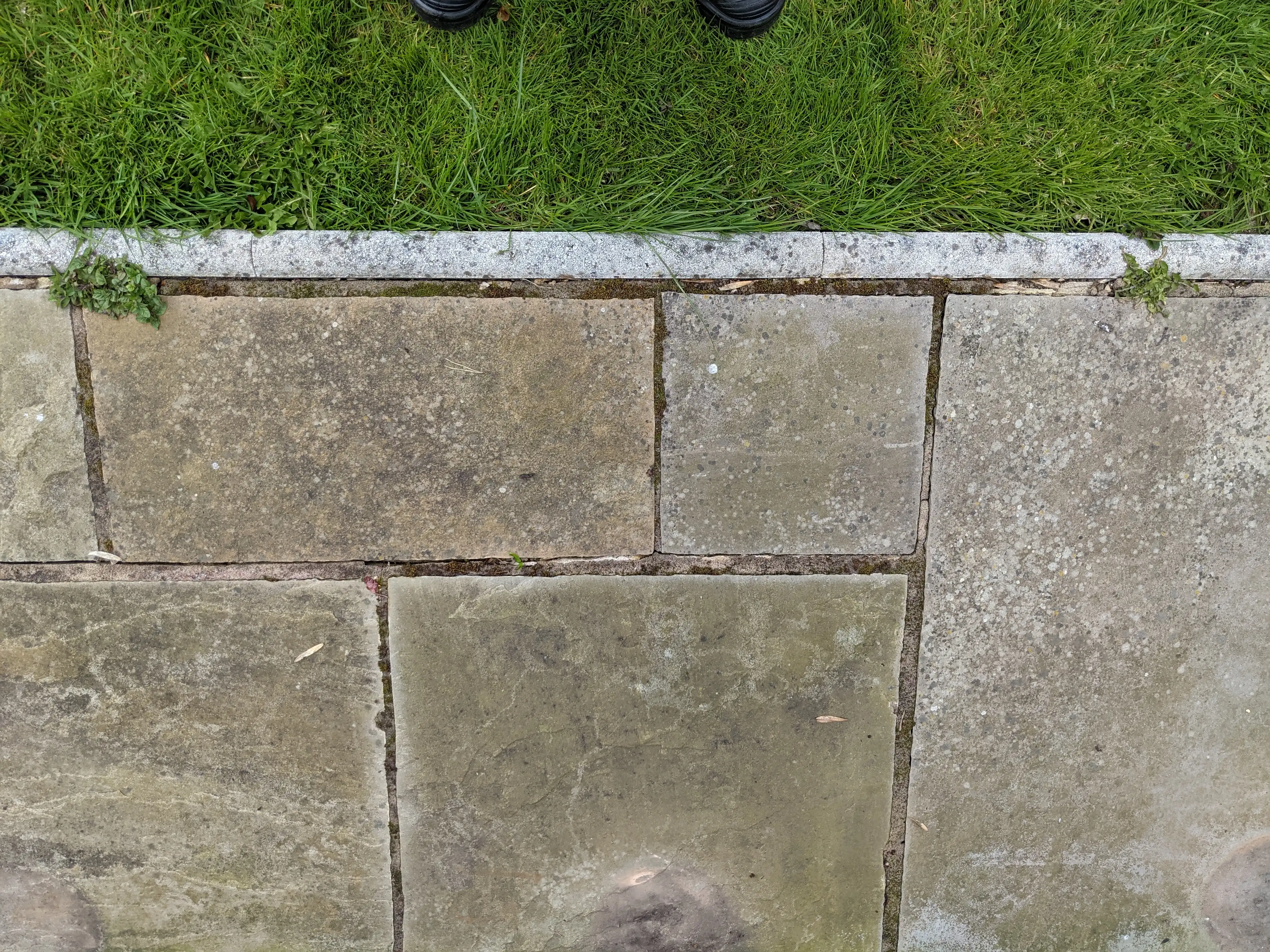
An ornamental sandstone patio had disappeared under black spot, algae and moss. Cleaned chemistry-first at low pressure, the stone's own colour came back — and the surface that carries that colour stayed exactly where it was.
Bringing the Colour Back to an Ornamental Sandstone Patio — Pressure Washing, Buckinghamshire
An ornamental sandstone patio had disappeared under black spot, algae and moss. Cleaned chemistry-first at low pressure, the stone's own colour came back — and the surface that carries that colour stayed exactly where it was.
Residential · Pressure Washing & Hardscape Restoration
SW-CASE-PW-RES-001
Wednesday, 14 April 2021
Ornamental garden patio and pathways (residential, non-listed)
Buckinghamshire · rural garden patio · open farmland aspect
Sandstone paving flags · sand and mortar joints · brick edging courses
The Pathology
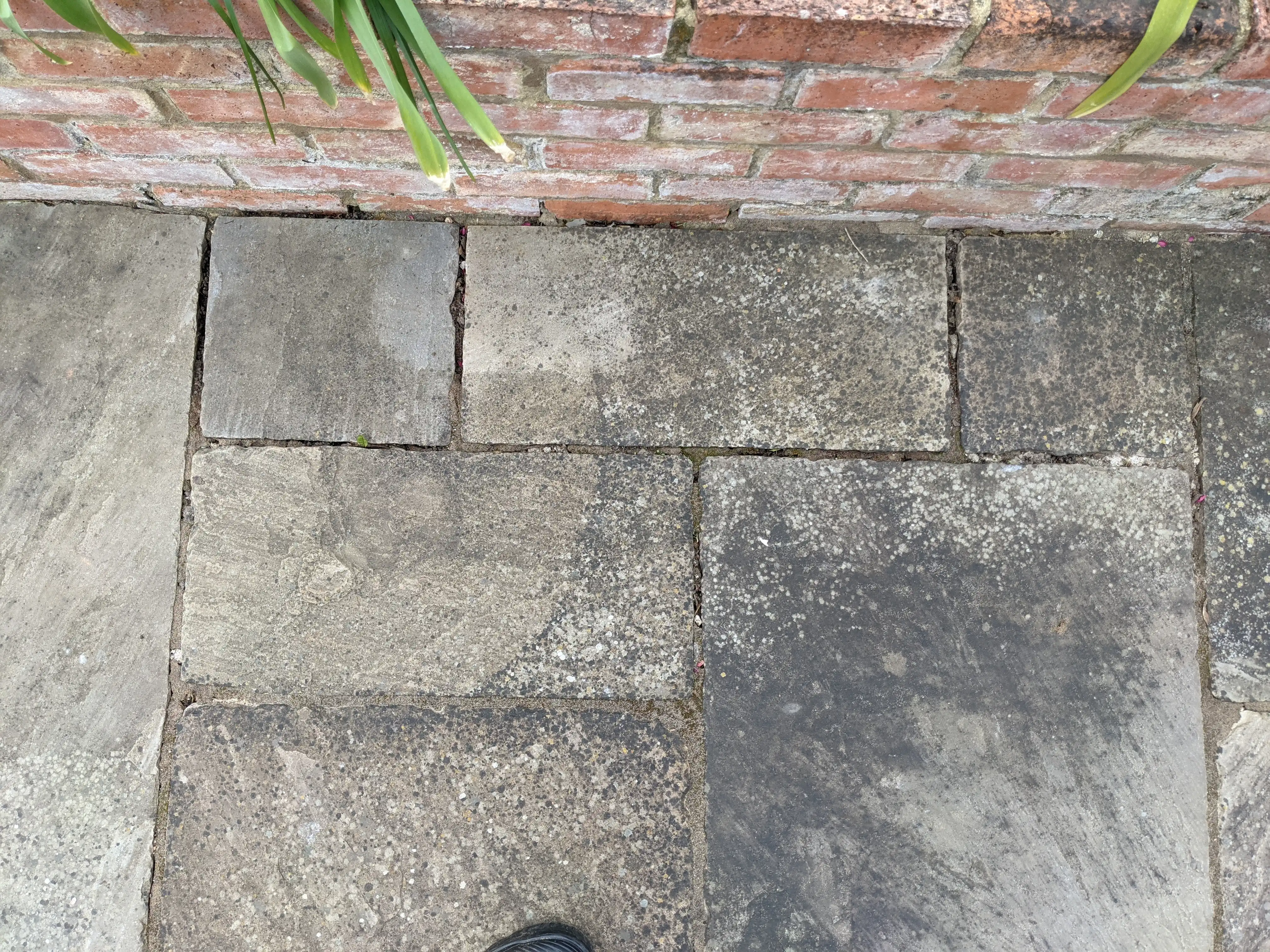
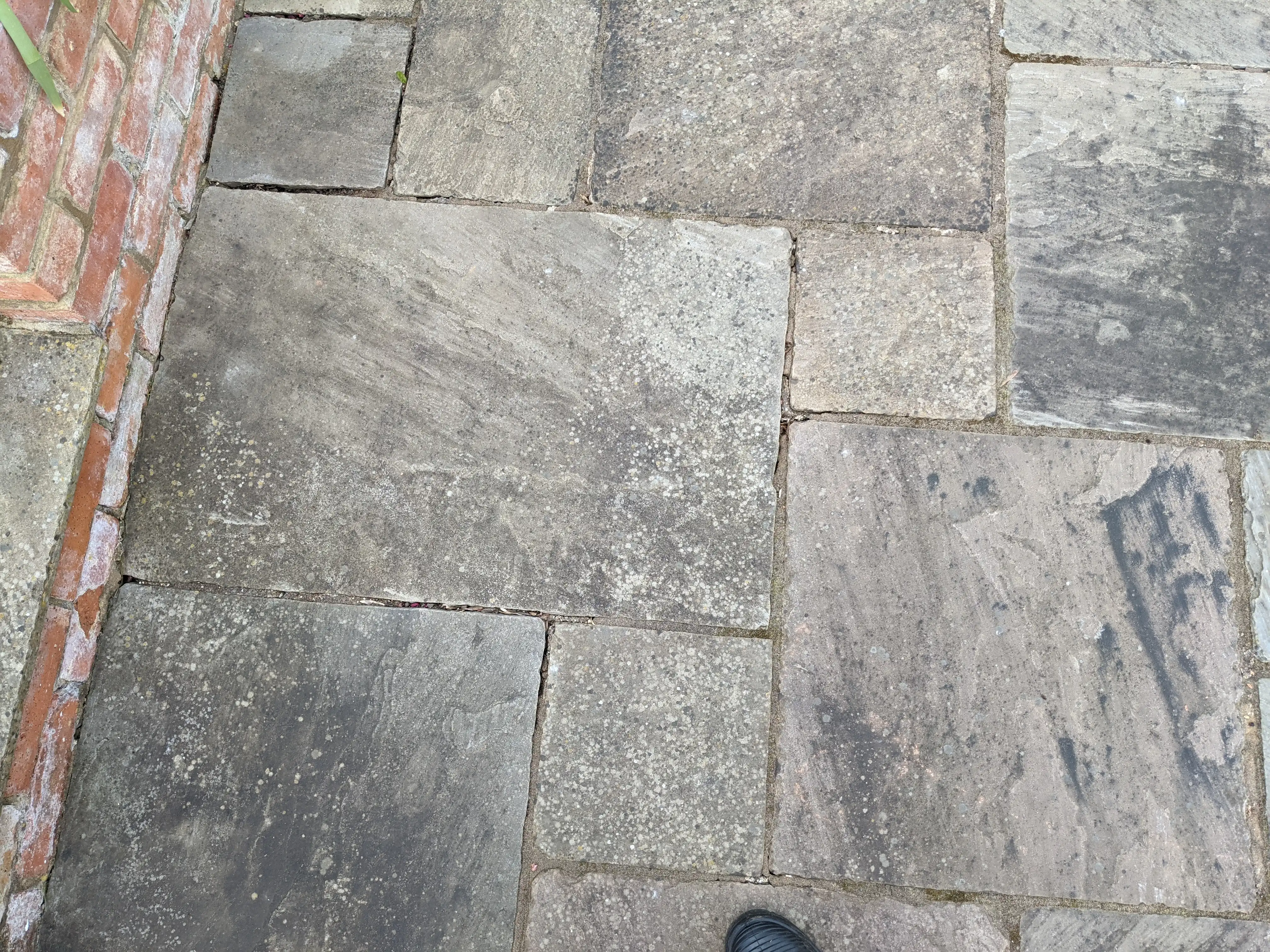
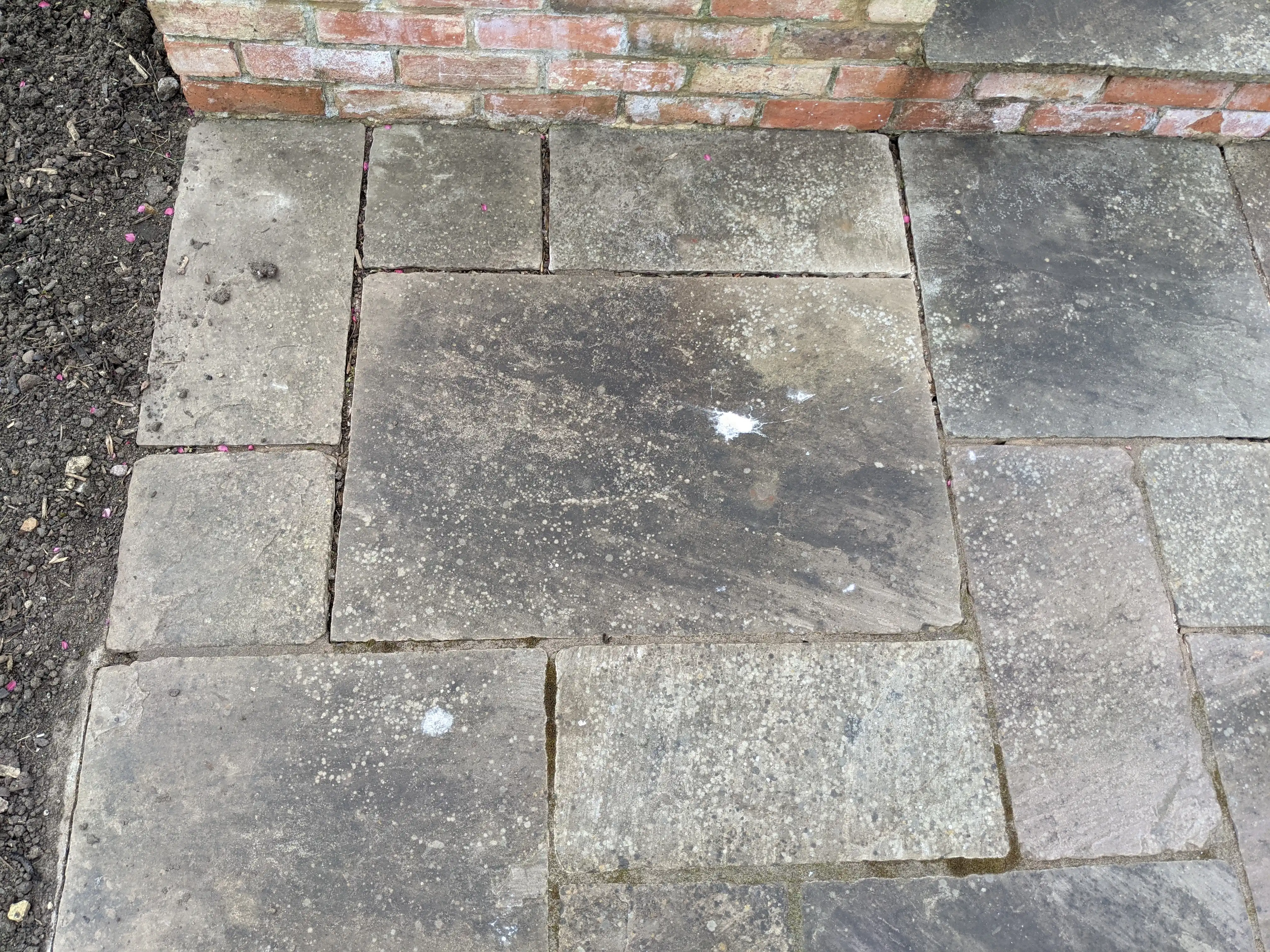
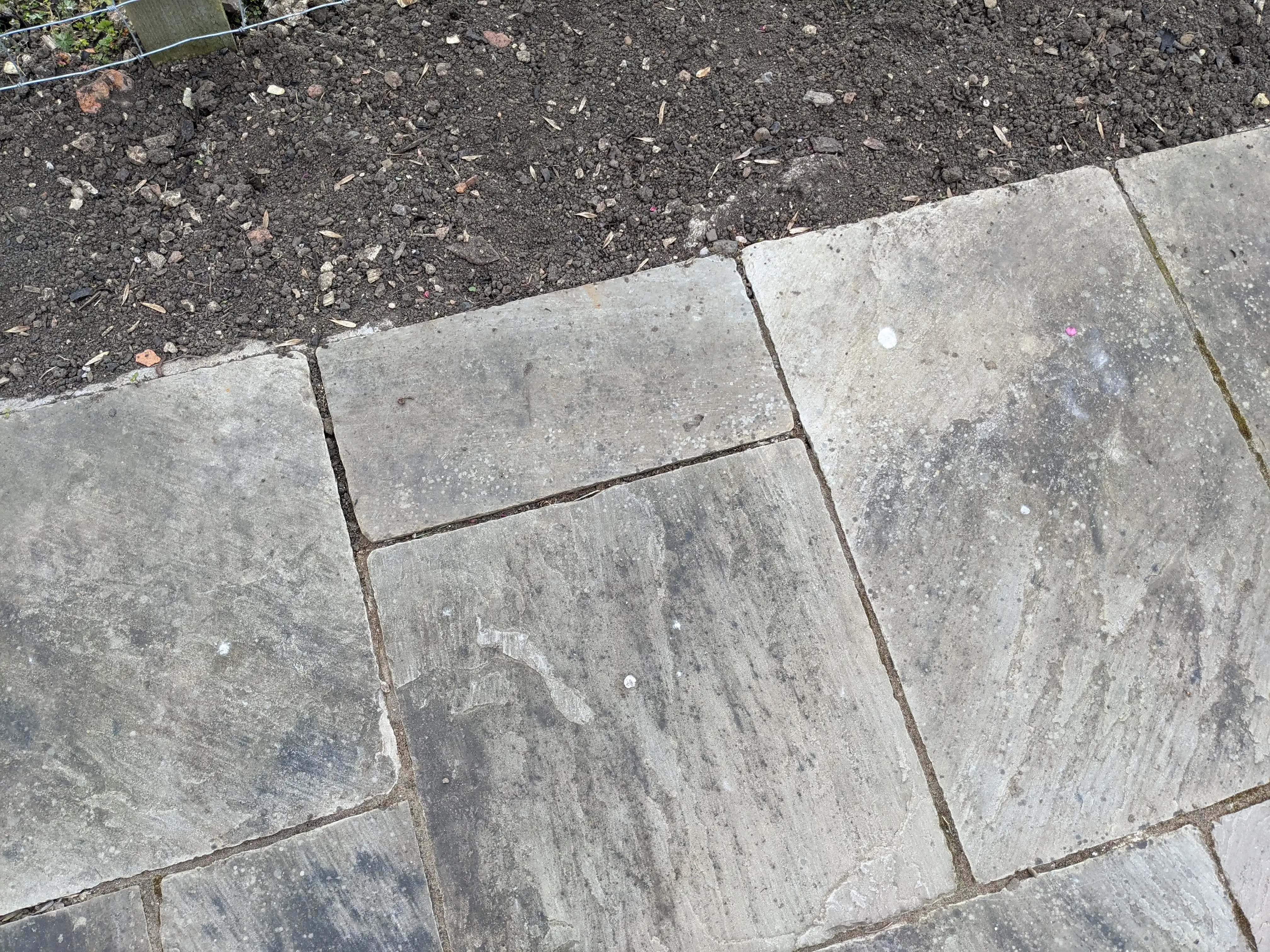
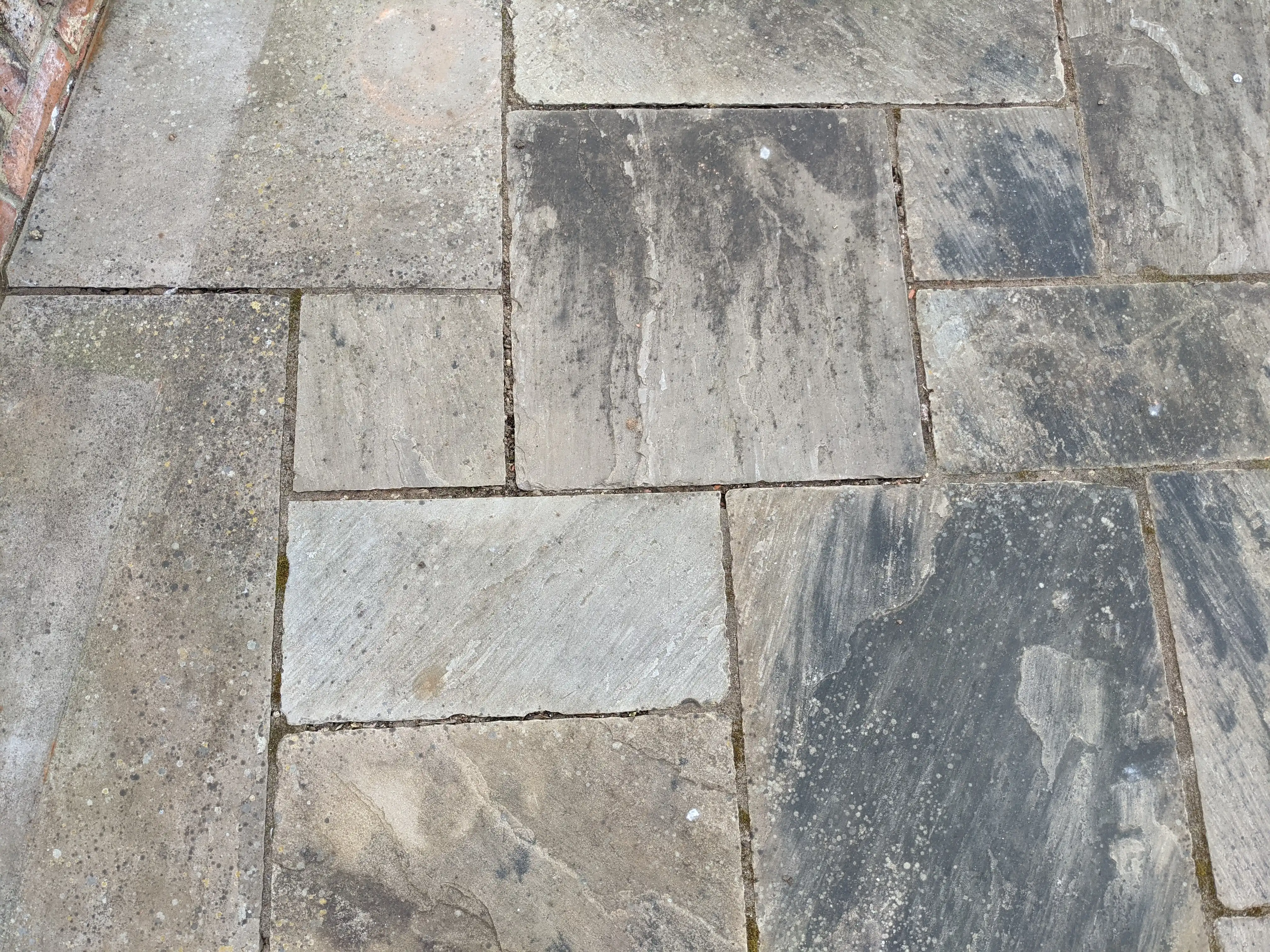
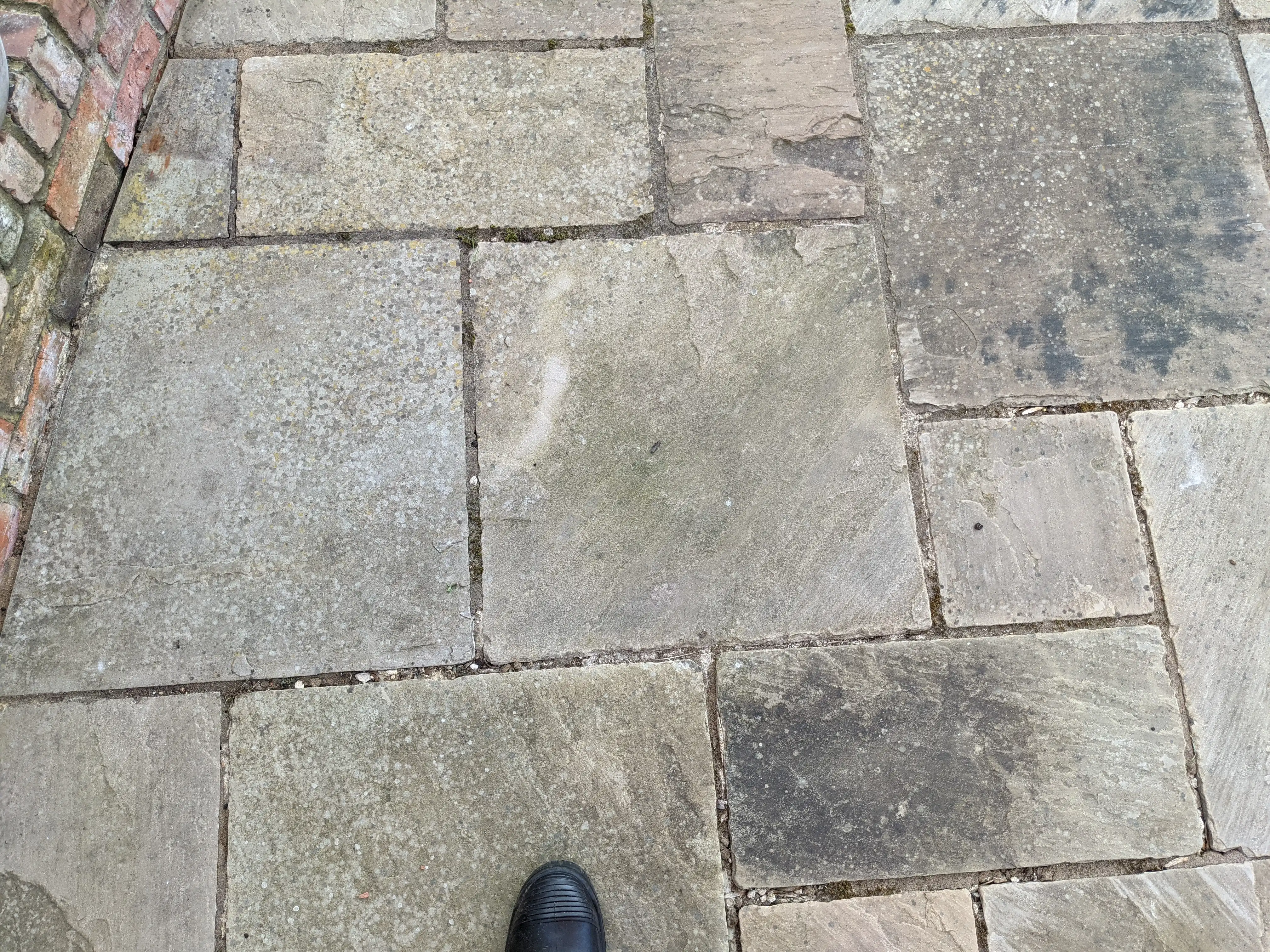
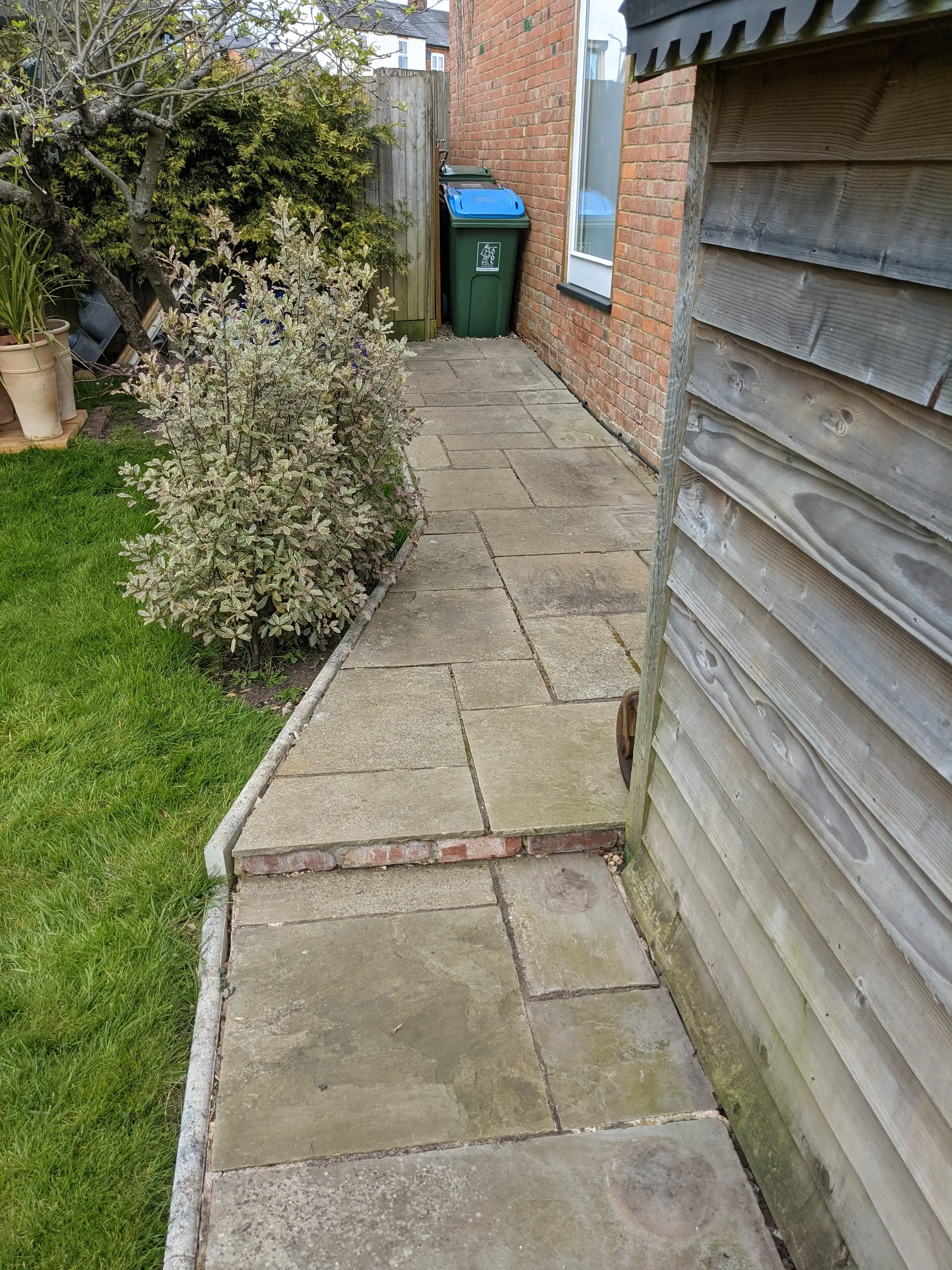
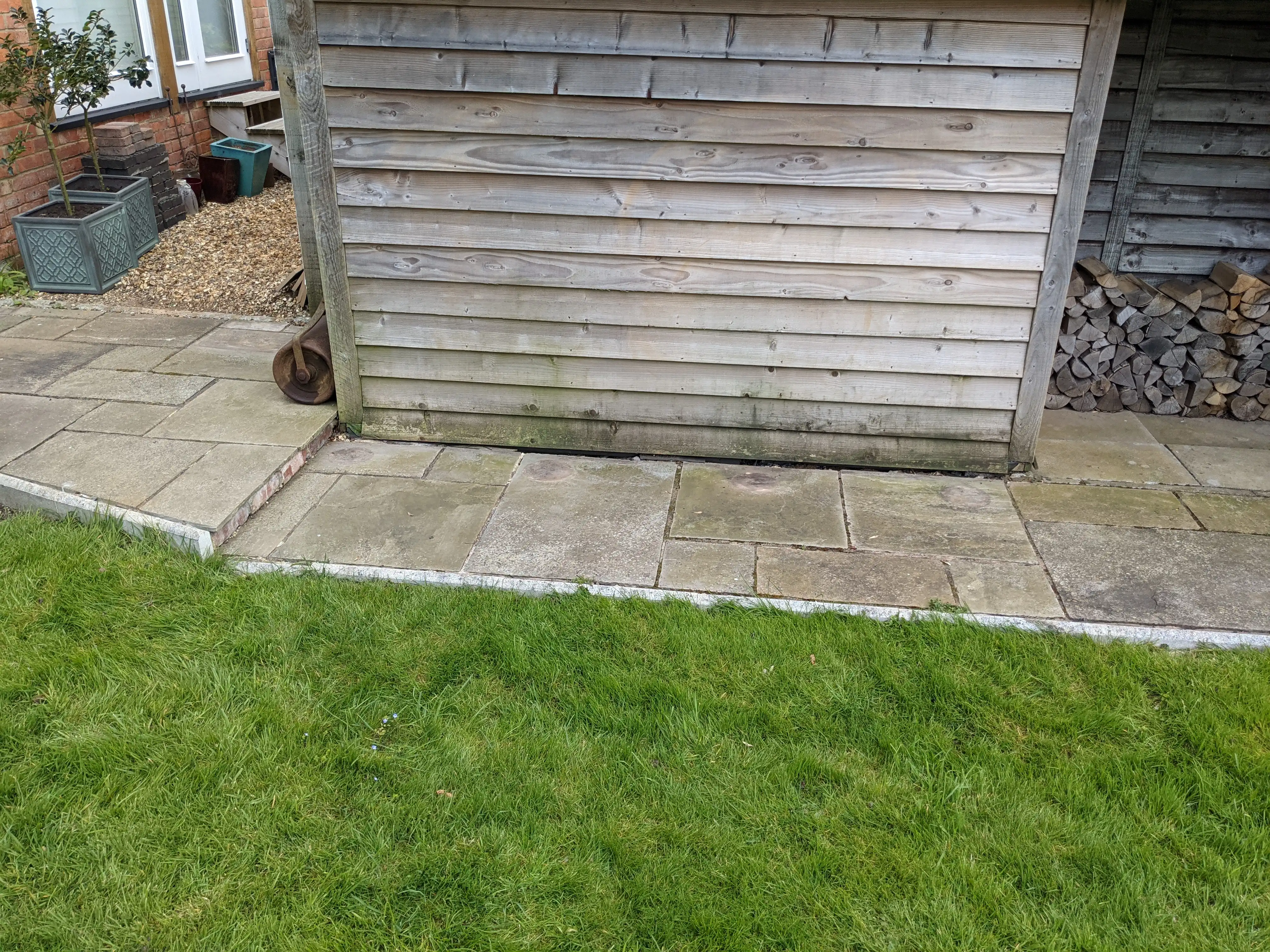
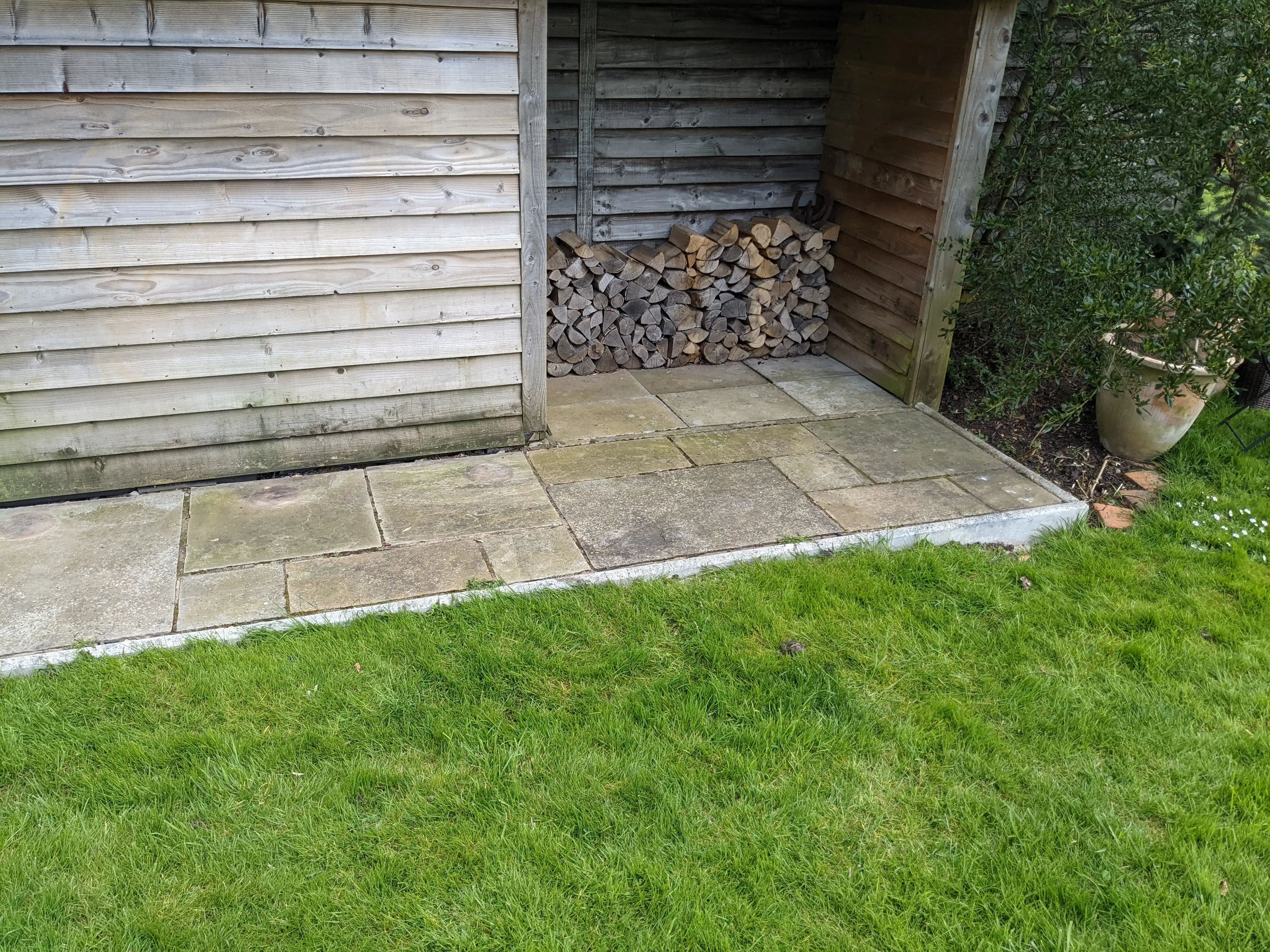
Sandstone is porous, and a horizontal slab is the wettest surface a property owns — it holds dew, rain and shade far longer than any wall. That sustained wetness had let a black crustose lichen anchor into the stone, green algal film spread across the open faces, and moss colonise the joints. The brick edging carried its own dark staining. None of it was dirt resting on the surface; it was living colonisation bonded into the outermost layer of the stone.
χ Drag Factor
χ — demonstrative: elevated pre-clean (biofilm-held moisture, colonised joints) → reduced post-clean and post-treatment
Biomass / Taxon
Black crustose lichen (Verrucaria-type) · green algal film · moss in joints · dark staining on brick edging
Atmospheric Log
Open farmland aspect; unobstructed exposure; heavy dew load and prolonged surface wetness on a horizontal plane

The Method
Sandstone is porous, and a horizontal slab is the wettest surface a property owns — it holds dew, rain and shade far longer than any wall. That sustained wetness had let a black crustose lichen anchor into the stone, green algal film spread across the open faces, and moss colonise the joints. The brick edging carried its own dark staining. None of it was dirt resting on the surface; it was living colonisation bonded into the outermost layer of the stone.
Sandstone is not one colour. A single patio can run through buff, honey, grey, rust and a soft pink, and those tones sit in the outermost skin of the stone — a layer thinner than a fingernail. It is why a good sandstone terrace looks like one thing at eight in the morning and something else entirely at sunset. It is also why a careless clean is so quietly destructive: strip that skin away and you remove the exact quality the stone was chosen for.
A patio is the wettest surface a house owns. A wall sheds water in seconds; a horizontal flag holds dew until mid-morning, holds rain in every joint, and sits in the shade of the building for half the day. In building-science terms its time-of-wetness is far higher than any elevation on the property, and moisture is the one thing biological colonisation needs above all others. Patios do not green over because they are neglected. They green over because they are flat.
The black spots that survive every brush are not marks; they are crustose lichen, and they are anchored rather than resting. A lichen of that type grips by chemistry, working into the surface layer and holding through anything a stiff broom can offer. That is why scrubbing shifts the green algae but leaves the black exactly where it was, and why there are only two honest options: release the anchorage chemically, or take away the stone underneath it.
So the order matters more than the machine. A biocidal pre-treatment goes on first and is given time to work, breaking the organism's hold while the pressure is still switched off. Only then does water get involved, and its job is simply to carry away what has already been released. Reverse that order and the pressure has to do the entire job on its own — which is precisely the moment the surface starts coming off along with the biofilm.
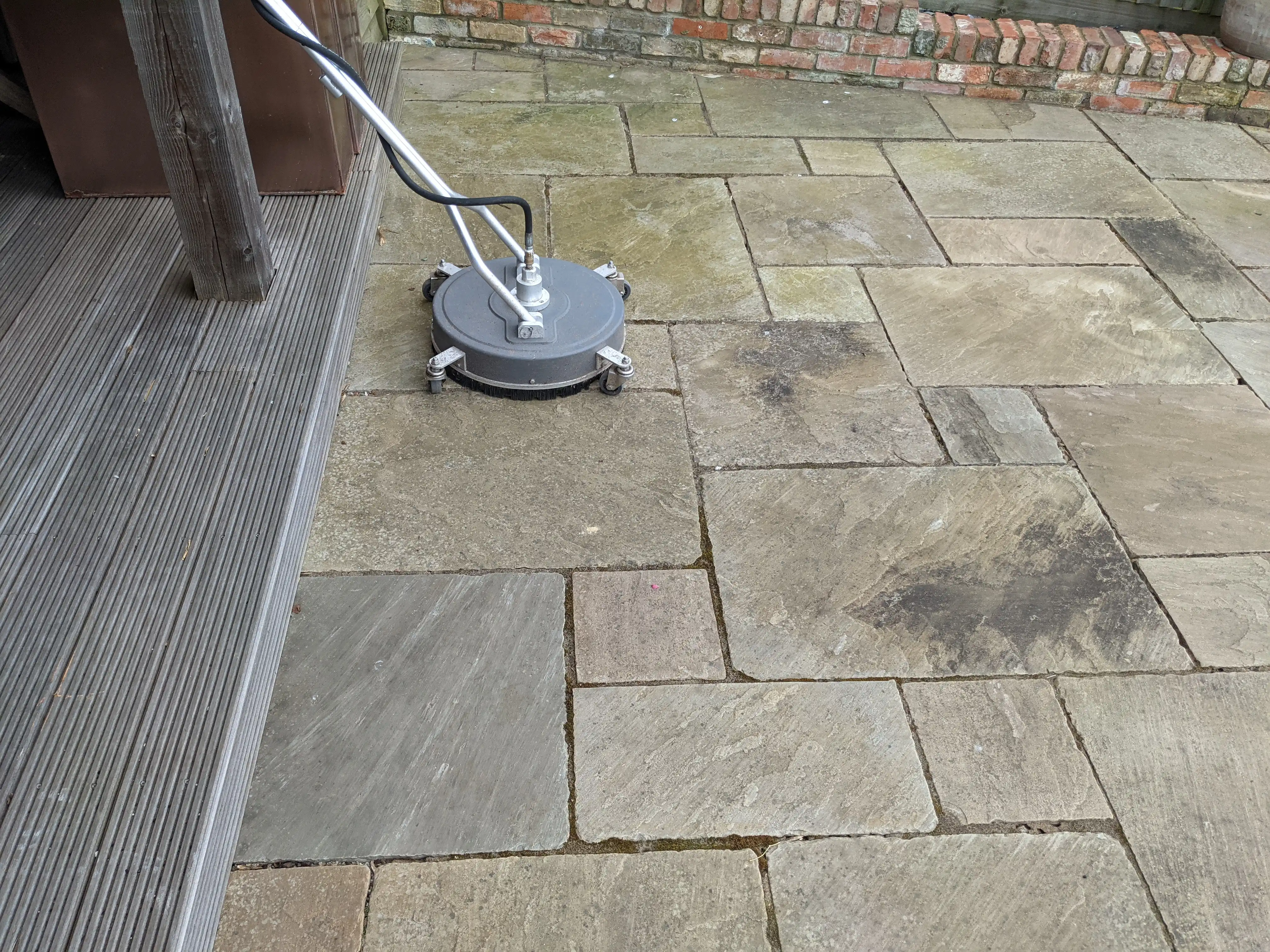
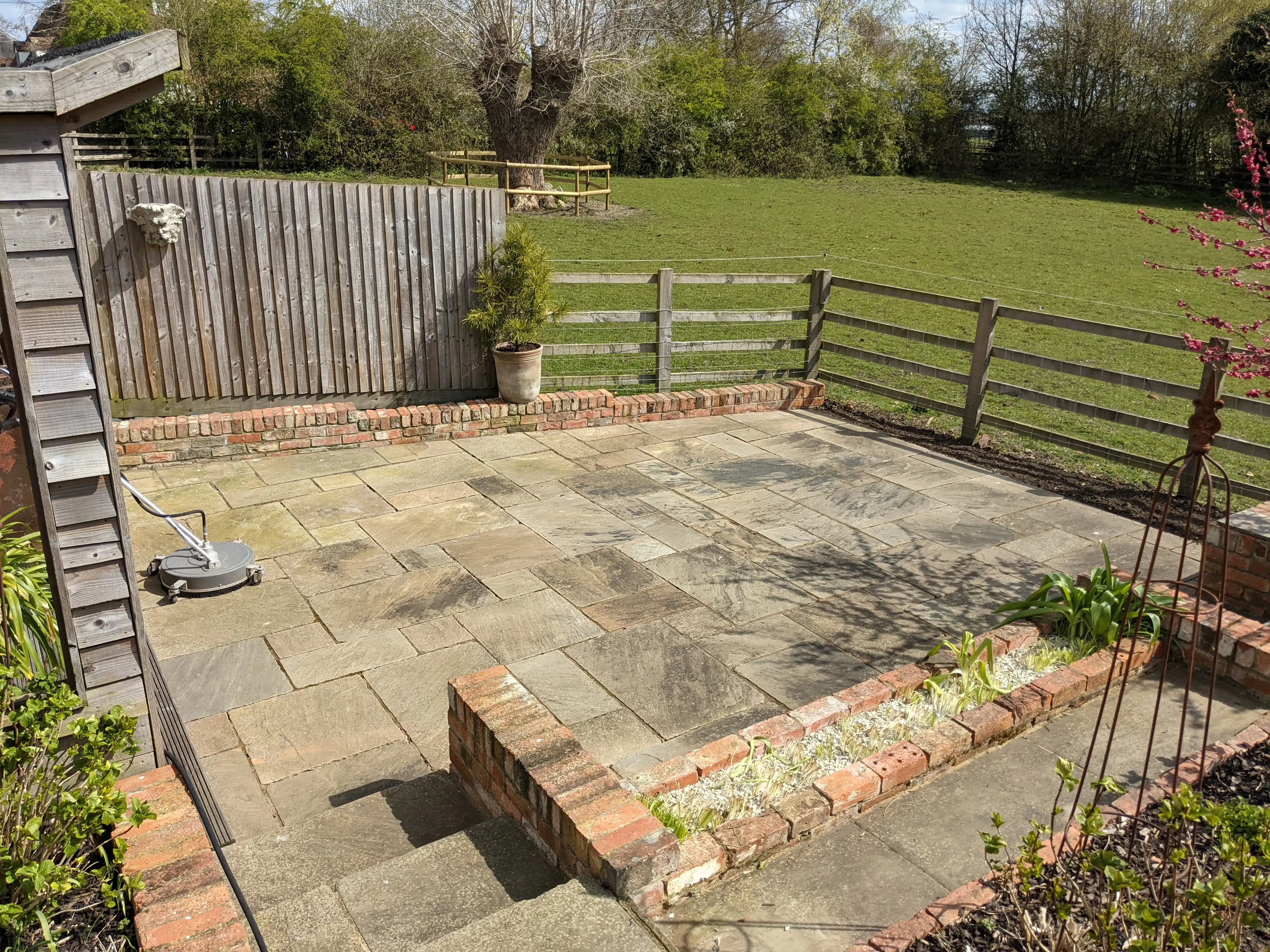
A rotary surface cleaner is the difference between cleaning a patio and eroding one. It spreads a fixed flow across a wide sweep, so no single point of stone ever takes the full force, and it holds a constant height and distance that no human hand can match over an afternoon. A lance with a turbo nozzle can do more harm in ten seconds than a season of weather — so here it came out only for spot work, at the lowest setting that would lift anything at all.
The joints matter as much as the flags. Concentrated pressure washes out jointing sand and mortar, and an open joint becomes a small reservoir that feeds the next colonisation from underneath — so a patio blasted clean in April is often greener by autumn than one cleaned gently. Distributing the flow keeps the joints where they belong. The brick edging was treated as its own substrate, softer and more absorbent than the paving, and cleaned to the same chemistry-first standard rather than swept along with the rest.
The last pass is the one nobody sees. A residual biocidal treatment goes down after the water has gone, so the stone is left hostile to the organisms that have just been removed rather than freshly cleared and freshly available. Without it, a patio is simply a clean, damp, open surface with every spore in the garden heading for it. That final step is most of the difference between a terrace that looks right for one summer and one that holds its condition through a full British year.
This one sat with open farmland behind it and nothing between the terrace and the horizon — the kind of garden that earns its stone. Full exposure means full dew, full rain and full light: hard on a surface, and glorious to stand on. Bringing the colour back to a patio like that is less a cleaning job than handing someone back a view they had slowly stopped noticing.
This case study is a demonstrative model of our method and standards. It is not a price list; every patio is assessed on its own stone, condition and jointing before any figure is discussed.
FAQ
Will pressure washing damage my sandstone patio?
It can, easily. Sandstone's colour sits in the outermost surface layer, and sustained high pressure removes it — leaving pale, roughened stone that then recolonises faster. The damage comes from method rather than from the machine: chemistry first, low pressure, and force spread rather than concentrated.
Why do the black spots stay after I have jet washed it?
Because they are lichen, not dirt. A crustose lichen anchors chemically into the surface layer, so water alone cannot release it. Either the anchorage is broken with a suitable treatment and dwell time, or the stone underneath comes away with it.
Why does my patio go green when the walls do not?
Because it is flat. A wall sheds water in seconds; a patio holds dew until mid-morning and water in every joint, so its time-of-wetness is far higher. Moisture is what colonisation needs most, so the horizontal surface always goes first.
Will the jointing sand get washed out?
Not if the flow is distributed rather than concentrated. A rotary surface cleaner spreads a fixed volume across a wide sweep, so no single joint takes the full force. Open joints are worth avoiding — they become reservoirs that feed the next colonisation from below.
How long will a sandstone patio stay clean afterwards?
Longer with a residual treatment than without one. Rinsing alone leaves a freshly available surface; a biocidal post-treatment leaves it hostile to regrowth. Aspect, shade and tree cover set the real interval, which is why we judge it per patio rather than by calendar.
The RIsk To Your Asset
The colour of sandstone lives in its top millimetre. Take that away and the flag goes pale, chalky and rough — and a roughened, more porous surface then holds water and organisms better than it did before, so the next colonisation arrives faster and harder than the last. The exposure on this job was never the black spot. It was the possibility of removing the very surface the owner was paying to see, and accelerating the decay while appearing to reverse it.
Surface loss · the colour lives in the top millimetre
Roughened stone · faster recolonisation
Material Substrate
Chemistry did the work; pressure only removed what chemistry had already released. A biocidal pre-treatment was applied and given dwell time to break the organisms' anchorage, then a rotary surface cleaner distributed a cold 15 litre-per-minute flow evenly across the flags rather than concentrating it in one spot. Stubborn areas were spot-treated and lifted with a lance at deliberately reduced pressure. A final biocidal pass was applied to slow recolonisation once the water had gone.
Chemistry first · pressure only lifts what is released
Distributed flow · surface cleaner, not a concentrated jet
Specification / Dataset
Substrate: sandstone paving flags · sand and mortar joints · brick edging courses
Colonisation: black crustose lichen · green algal film · moss in joints · staining on brick
Sequence: biocidal pre-treatment → dwell → rotary surface clean → spot pre-treat → low-pressure lance → biocidal post-treatment
Equipment: cold-water pressure washer at 15 L/min · rotary flat-surface cleaner · lance and turbo nozzle held at reduced setting
Pressure policy: lowest effective setting throughout; no sustained high pressure held on any flag
Joints: preserved — flow distributed across the sweep rather than concentrated into the joint line
Edging: brick treated as a separate, more absorbent substrate to the same chemistry-first standard
Aftercare: residual biocidal treatment applied after rinse-down to extend the interval before regrowth
Figures: demonstrative — surface area, dwell times and re-clean interval to be field-captured
OUR PROTOCOL
Sandstone paving flags · sand and mortar joints · brick edging courses
BIOLOGICAL AGENT
Black crustose lichen (Verrucaria-type) · green algal film · moss in joints · dark staining on brick edging
SITE / ENVIRONMENT
Buckinghamshire · rural garden patio · open farmland aspect
FORENSIC DETAIL
Sandstone is porous, and a horizontal slab is the wettest surface a property owns — it holds dew, rain and shade far longer than any wall. That sustained wetness had let a black crustose lichen anchor into the stone, green algal film spread across the open faces, and moss colonise the joints. The brick edging carried its own dark staining. None of it was dirt resting on the surface; it was living colonisation bonded into the outermost layer of the stone.
OUTCOME
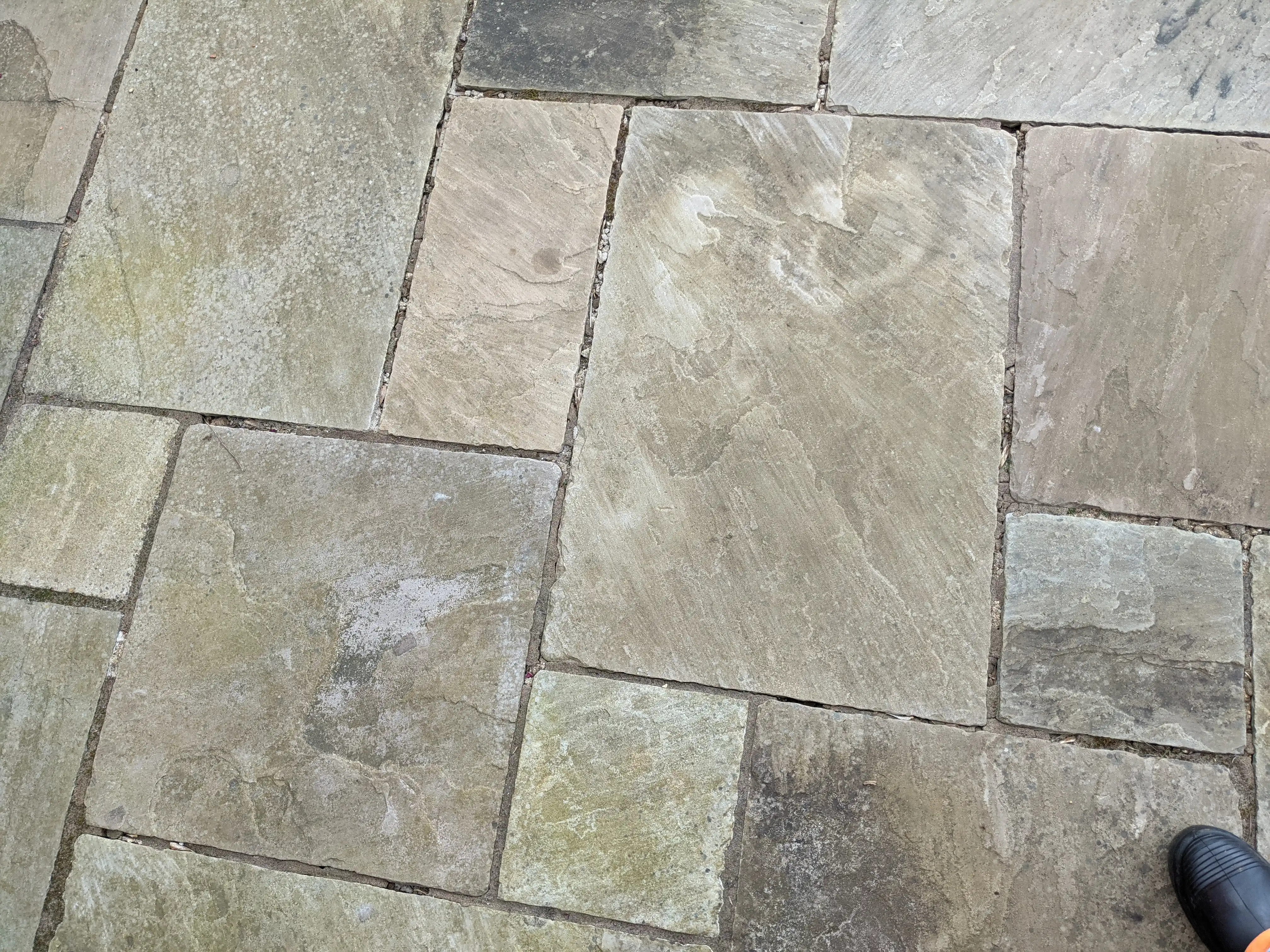
The stone's natural colour variation returned across the full area, the joints were left intact, and the brick edging cleared. A residual biocidal treatment was left in place to extend the interval before regrowth. Figures here are demonstrative — surface area, dwell times and re-clean interval to be field-captured.
Your Built Environment
Diverse solutions tailored to your every need

Browse the Shop & Pricing
See every service with clear, upfront pricing — no hidden quotes. Add what you need to your basket and book it in a few clicks, whenever it suits you.

Create & Manage Your Account
Register a free account to manage your services, see past visits and rebook in seconds. Everything about your property's care, in one place.

View the Calendar
See when we're free and choose a date that works for you. Prefer a tailored quote first? Tell us what you need and we'll come straight back.
Book These Services Directly Online






Explore how we restore and protect other residential, commercial, and heritage properties using our evidence-based methods.


